2.3.2 Copper-Catalyzed Reactions
CuH is found to be highly efficient catalyst for the asymmetric reductive aldol cyclization of keto-enones to give the target product as a singly diastereoisomer with high enantiopuritiy (Scheme 8). These reactions use ferrocenylphosphines, (S, R)-PPE-P(t -Bu)2, as effective chiral ligands in the presence of silane as a hydride source (Scheme 8). These reactions can also be carried out under heterogeneous as well as aqueous conditions with surfactant.
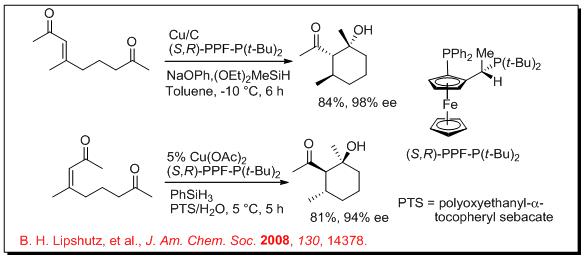
Scheme 8
2.3.3 Palladium-Catalyzed Reactions
The palladium-catalyzed cross-coupling reactions of aryl or alkenyl halides with alkenes in the presence of base are among the powerful reactions in organic synthesis to construct carbon-carbon bonds. The asymmetric version of the reaction is also well explored. Scheme 9-12 illustrates some examples for the intramolecular and intermolecular Heck reactions. In 1970, the Heck reaction was discovered and, in 1989, the first example of asymmetric intramolecular Heck reactions appeared using Pd(OAc)2 with (R)-BINAP with moderate enantioselectivity (Scheme 9).
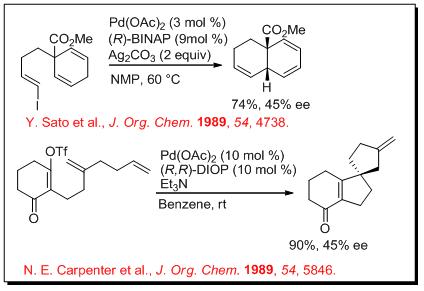
Scheme 9
The intramolecular Heck reaction finds wide applications in organic synthesis. Among those applications the synthesis of optically active oxindoles having a quaternary asymmetric center has been considerably explored. Because the oxindole moiety serves as useful synthetic intermediate in the synthesis of numerous natural products. For example, (E)- α,β -unsaturated-2-iodoanilide undergoes cyclization in the presence of Pd2 (dba)3-CHCl3 and (R)-BINAP to give oxindoles with (S) or (R) configuration under cationic and neutral conditions, respectively. It is noteworthy that a dramatic switching in the direction of asymmetric induction has been observed between the two conditions even though the same chiral ligand (R)-BIANP is employed. In these reactions, Ag3PO4 and PMP act as HI scavenger.
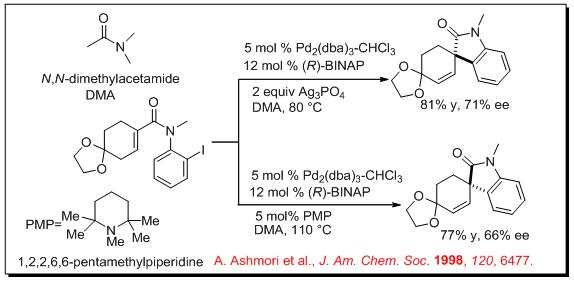
Scheme 10