2.3 Carbometallation and Carbocyclization Reactions
Organometallic compounds add to carbon-carbon multiple bonds to give a new organometallic species, which could be further modified to yield new carbon-carbon bonds. These processes are called as “carbometallation reactions”. It primarily refers to the relationship between the reactants and products (Scheme 1). This lecture covers some examples of the asymmetric carbometallation reactions using Rh, Cu and Pd-based systems.
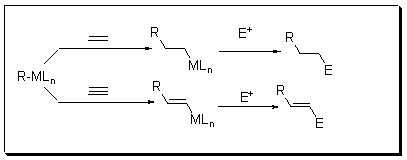
Scheme 1
2.3.1 Rhodium-Catalyzed Reactions
Hydrogen-mediated carbon-carbon bond formation has emerged as powerful industrial process in chemical industries. For example, the hydroformylation and Fischer-Tropsch reactions are well known for the hydrogen-mediated carbon-carbon bond formation reactions. These processes require heterolytic activation of molecular hydrogen to give monohydride species, where the C-H reductive elimination pathway is disabled. Addition of a metal hydride to carbon-carbon multiples bonds (i.e., alkene and alkyne) give organometallic species that could be rapidly captured by an electrophile (i.e., aldehydes and imine) prior to its reaction with molecular hydrogen via oxidative addition or σ-bond metathesis of carbon-metal bond. Scheme 2 illustrates metal-dihydride route (leading to hydrogenation) and metal-monohydride route (leading to C-C bond formation) with an alkyne.
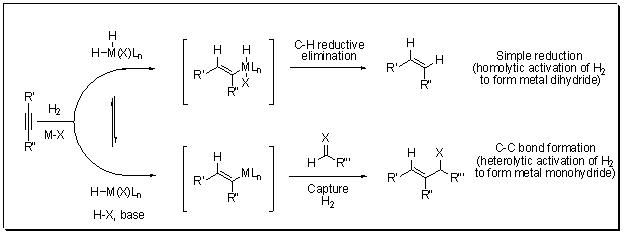
Scheme 2
Formation of the monohydride organometallic species depends on the choice of the catalytic system. For example, the heterolytic activation of molecular hydrogen is observed with cationic rhodium complexes in the presence of base. The reaction takes place via the oxidation addition of the molecular hydrogen with metal species followed by a base induced reductive elimination of HX (Scheme 3).

Scheme 3