For example, Scheme 4 presents enantioselective reductive cyclization of 1,6-enynes using Rh(COD)2 OTf and ( R )-BINAP in the presence of molecular hydrogen. This carbocyclization reaction is compatible with various functional groups, however, the yield and enantioselectivity of the product depends on the structure of 1,6-enynes and the ligands.
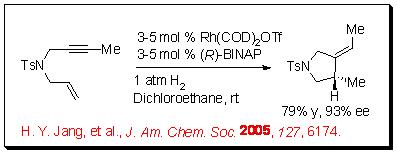
Scheme 4
A possible mechanism has been proposed for this reaction based on deuterium labeling control experiments (Scheme 5). The catalytic cycle starts with cycloaddition of RhLn and 1,6-enyne forming rhodacyclopentene. Homolytic hydrogen activation via oxidative addition of molecular hydrogen or σ-bond metathesis may lead to the formation of vinyl-rhodium vinyl species that could afford cyclization product by reductive elimination to complete the catalytic cycle.
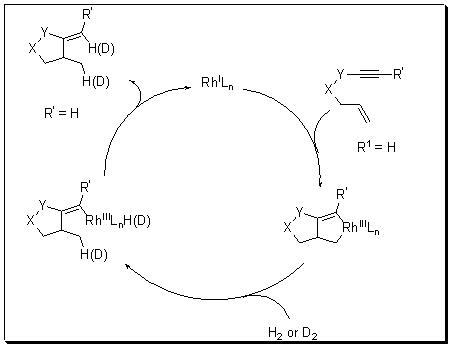
Scheme 5
1,4-Conjugate addition of organometallic reagents to α,β -unsaturated carbonyl compounds afford effective method for carbon-carbon bond formation. Much effort has been on the development of asymmetric version of the reaction using a series of catalytic systems. The first reductive aldol cyclization of keto-enone with phenylboronic acid has been shown utilizing Rh[(COD)Cl]2 and (R)-BINAP with yield and enantioselectivity (Scheme 6).
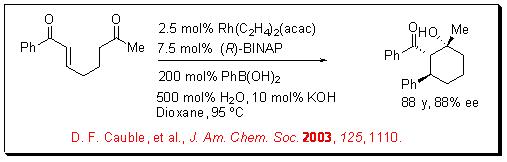
Scheme 6
The mechanism of the reaction is presented in Scheme 7. The observed stereochemistry has been rationalized by assuming Z -enolate formation.
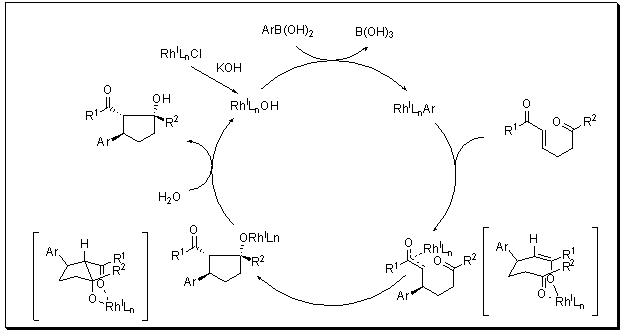
Scheme 7