3.8.4.2 Chromium-Carbene Complex
Metal carbene complexes have received a great important in organic synthesis. Chromium forms Fischer-type carbene complexes. The usual method of synthesis involves the addition of an alkyl lithium to hexacarbonylchromium(0) followed by O -methylation (Scheme 8).
 |
Scheme 8 |
These Fischer-type carbenes serve as reagents for various carbon-carbon bond formations such as Aldol and Micheal-addition, cycloaddition, benzannulation and cyclopropanation reactions. The reactions are believed to take place via insertion of an alkene or alkyne to the carbene to form a new carbene complex which undergoes further reaction. For an example, methoxycarbene chromium complexes bearing α,β -unsaturated carbene side chain react with alkyne under mild conditions to give Cr(CO3 )-hydroquinones via a [3+2+1]-cycloaddition along with the Cr(CO3 ) fragment mediates the stepwise coupling of aryl carbene C3 -synthon with an alkyne C2 -unit and a carbonyl C1 -building block (Scheme 9-10).
 |
Scheme 9 |
Mechanism
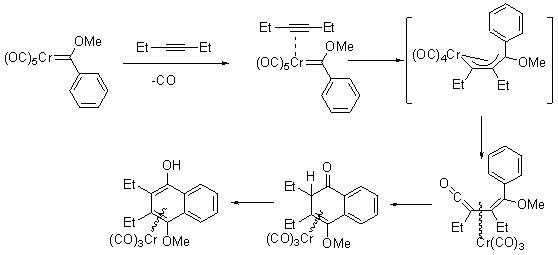 |
Scheme 10 |
Reaction of diazo compound with vinyl ethers in the presence of (cyclooctene)chromium(0) leads to cyclopropanes in moderate to good yields and stereoselectivities (Scheme 11). The reaction is catalytic and the results are comparable to the rhodium-catalyzed cyclopropanation reactions. The carbene transfer occurs with retention of configuration.
 |
Scheme 11 |