Ring Lithiation
The ring deprotonation of arylchromiumtricarbonyl complex occurs to allow the regioselective preparation of a variety of alkylated complexes under mild conditions. Highly enantioselective deprotonation of prochiral substrates is possible in the presence of chiral bases (Scheme 5).
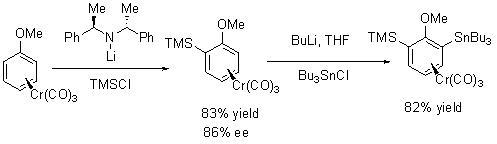 |
Scheme 6 |
Catalysis
Arene-Cr(CO)3 is a good source for the generation of ‘free' Cr(CO)3 unit that catalyzes useful organic transformations. For examples, the selective 1,4-hydrogenation of 1,3-dienes give Z-configurated alkenes (Scheme 6). Only 1,3-dienes that can adopt a s-cisoid conformation is compatible, under these conditions isolated double bonds are not affected. While naphthalene-Cr(CO)3 complex catalyzes 1,5-hydrogenation.
 |
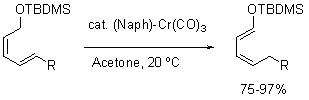 |
Scheme 6 |
Arylchromiumtricarbonyl complexes have been employed in Zn-mediated Reformatzky-type alkylation reactions (Scheme 7). For an example, enantiomerically pure chromiumtricarbonyl complexes of benzaldimines react with bromoesters to afford stereoselectivly (ee > 98%) β -aminoesters and β -lactams (Scheme 7)
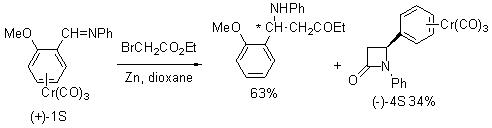 |
Scheme 7 |