Organochromium based methods have been studied for a wide range of important organic transformations. This section covers the more significant methodological developments.
3.8.4.1 Reactions of Chromium-Arene Complex
Nucleophilic Substitution
B enzene and its derivatives react with chromium hexacarbonyl to give arylchromiumtricarbonyl complexes. In the complex, chromium resides in a position perpendicular to the plane of the ring, and the aryl ring is activated towards nucleophilic attack by metal complexes (Scheme 1). For example, arylchromiumtricarbonyl complexes can be used for the synthesis of alkyl substituted products by treatment with organolithium reagents, followed by treatment with electrophiles (Scheme 2).
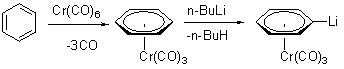 |
Scheme 1 |
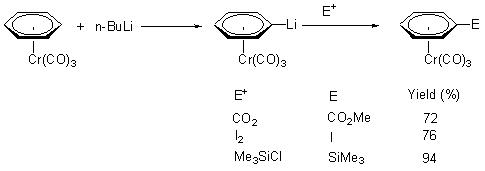 |
Scheme 2 |
The arylchromiumtricarbonyl complex can also undergo nucleophilic aromatic substitution with carbon nucleophiles (Scheme 3). The mechanism involves the addition of nucleophile (R−) to the aromatic ring to generate a chromium stabilized carbanionic complex. The metal stabilized anion intermediate can be decomposed by reaction with iodine or by protonolysis to give substituted products. However, the addition of nucleophile can also be reversed on heating the carbonionic arylchromiumtricarbonyl complex.
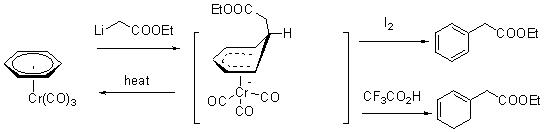 |
Scheme 3 |
When the benzene ring is functionalized, ortho, meta or para isomers are possible upon reaction of the chromiumtricarbonyl complex with nucleophiles.
Asymmetric version of the reaction has been developed in the presence of chiral ligands. For an example, substituted arylchromiumtricarbonyl in the presence of (-)-sparteine undergoes reaction with PhLi, followed by propargyl bromide to give cyclohexadiene derivative in moderate enantioselectivity (Scheme 8).
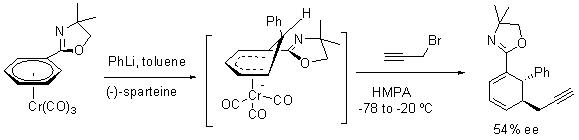 |
Scheme 4 |