3.7.2 Heck Reaction
The palladium-catalyzed C-C cross-coupling of alkenes with alkenyl triflates (bromides, iodides) and aryl triflates (bromides, iodides) to give substituted alkenes in the presence of stoichimoetric amount of triethylamine is called Heck Reaction (Scheme 4). The amine serves to reduce Pd(II) to the catalytically active Pd(0) complex. The amine also plays an important role in that it neutralizes the acid formed in the reaction (TfOH, HBr or HI).
 |
Scheme 4 |
Mechanism
Pd(II) is reduced to active palladium(0) complex that undergoes oxidative addition with the alkenyl triflates to give organopalladium(II) complex. The latter proceeds cis -selective addition to the alkene double bond. This is a carbopalladiation of the double bond. The addition product is an alkyl-Pd(II) complex. The newly formed C-C bond undergoes rotation to bring an H- β atom and the PdLx group into syn complex to occur β -hydrdie elimination. (Scheme 5). The base regenerates the catalyst.
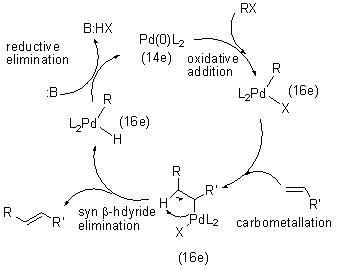 |
Scheme 5 |
Asymmetric Reactions
Asymmetric Heck reaction has been extensively studied. For an example, the Heck reaction of phenyl triflate with dihydrofuran has been accomplished using the amino acid-derived phosphine ligand with high enantioselectivity (Scheme 6).
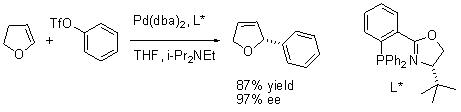 |
Scheme 6 |