The organopalladium compounds are generated in situ for the synthesis. The importance organopalladium compounds lies in their ability to facilitate reactions that would not takes under normal conditions. This section covers the palladium-catalyzed C-C bond formations.
3.7.1 Suzuki-CouplingThe palladium-catalyzed C-C cross-coupling of organoboranes, organoboronic acids, and organoboronic esters with organic halides is called ‘Suzuki coupling'. This reaction has become extremely popular and covers about a quarter of all palladium-catalyzed coupling reactions (Scheme 1). The initial process consists of hydroboration of an alkyne with borane, followed by palladium(0)-catalyzed C-C cross-coupling of the organoborane with aryl halides. The hydroboration is usually regioselective for the less hindered position and addition of boron and hydrogen occurs cis stereospecifically
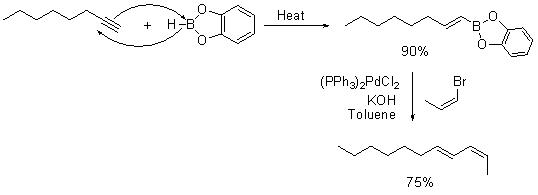 |
Scheme 1 |
Mechanism
The major difference of the Suzuki cross-coupling with the other cross-coupling reactions is the need of one equiv of a base due to the activation of the organopalladium halide complex A by conversion into the organopalladium alkoxide B. Due to the low nucleophilicity of the organoboron, the transmetallation takes place faster with B compared to A to give the intermediate C that can complete the catalytic cycle by reductive elimination (Scheme 2)
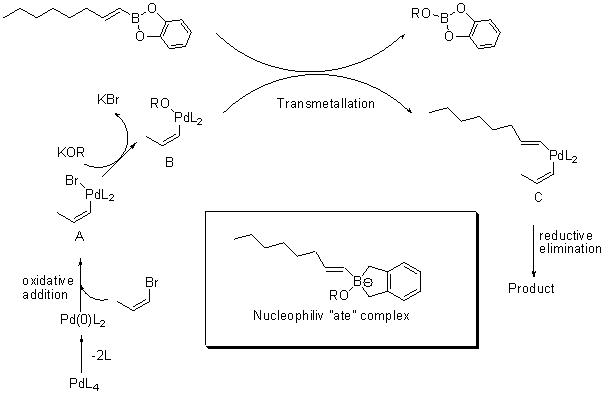 |
Scheme 2 |
For an example, the synthesis of bombykol can be accomplished by C-C cross-coupling from vinyl boronic acid and vinyl bromide using Pd(PPh3)4 in the presence of NaOEt (Scheme 3). The reaction stereoselectivly affords the product in 82% yield.
 |
Scheme 3 |