Mechanism
The mechanism for the alkaline hydroperoixde mediated oxidation of ketone to ester follows (Scheme 8).
 |
Scheme 8 |
1.5.5 Hyderoperoxide Rearrangement
Hyderoperoxide in the presence of strong acid such as H2SO4, HClO4 and Lewis acids undergoes rearrangement as Baeyer-Villiger oxidation. For example, cumene hydroperoxide in the presence of H2SO4 undergoes rearrangement via hemiacetal to give phenol and acetone (Scheme 9). The cumene hydroperoxide can be obtained by autooxidation of cumene. This is the commercial process used for the synthesis of phenol.
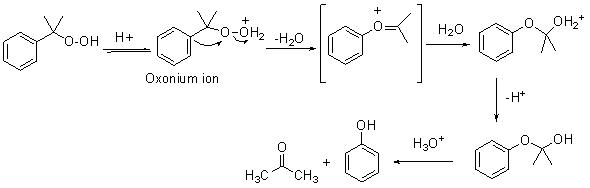 |
Scheme 9 |
Under these conditions, 1-methylcyclohexyl hydroperoxide rearranges to give 7-hydroxyhept-2-one (Scheme 10).
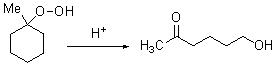 |
Scheme 10 |
1.5.6 Dakin Reaction
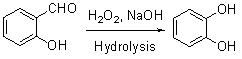
Phenolic aldehydes and ketones proceed reactions with alkaline H2O2 to replace the aldehyde or acetyl group with OH group, which is called Dakin reaction. For example, salicylaldehyde is transformed into catechol in 70% yield (Scheme 11).
 |
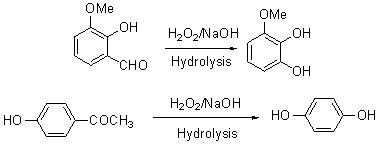 |
Scheme 11 |