·
1.5.3.2 Epoxidation of α,β-Unsaturated Carbonyl Compounds
Alkaline-H2O2 is used for the epoxidation of α,β-unsaturated carbonyl compounds (Scheme 3). The method is straight forward and the products are obtained in high yield.
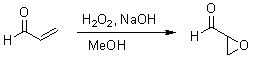  |
Scheme 3 |
1.5.3.3 Asymmetric Epoxidation
Asymmetric epoxidation is one of the most selective methods for the formation of enantiomeric products. The asymmetric epoxidation of allylic alcohols with t-BuOOH, Ti(OiPr)4 and tartrate ester, called Sharpless asymmetric epoxidation, provides the epoxides with high enantiomeric excess and yield (Scheme 4). This reaction has been used for the synthesis of many important natural products and biologically active molecules.
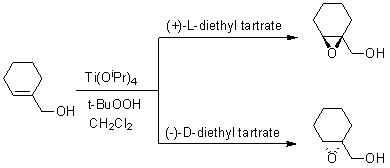 |
Scheme 4 |
The mnemonic rule for the absolute configuration of the epoxy alcohol is as follows, if the CH2OH group is in lower right or upper left of the double bond then the epoxide is formed at the upper face of the double bond when (+)-L-diethyl tartrate is used and at lower face when (-)-D-diethyl tartrate is used (Scheme 5). The reaction works catalytically when 3Å or 4Å molecular sieves are used as an additive.
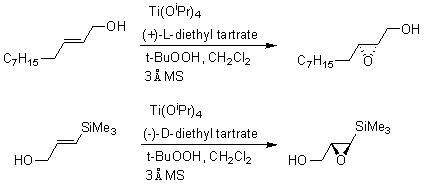 |
Scheme 5 |