· Mechanism
The proposed mechanism is similar to that of allylic oxidation i.e. ene reaction followed by
[2,3]-
sigmatropic rearrangement and then elimination gives the desired 1,2-dicarbonyl compounds (Scheme 4).1
 |
Scheme 4 |
1.4.1.3 Oxidation of Alkynes
In the presence of acid, SeO2 oxidizes alkynes to give 1,2-dicarbonyl compounds. Internal alkynes can be converted into 1,2-diketones, where as terminal alkynes are transformed into glyoxylic acid (Scheme 5).
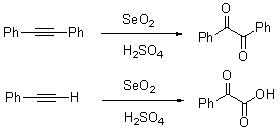 |
Scheme 5 |
1.4.1.3 Benzylic Oxidation
SeO2 is also capable of oxidizing benzylic C-H bond to give aldehydes or ketones (Scheme 6). When the methylene group is flanked by two aromatic rings, the methylene is readily converted into ketone.
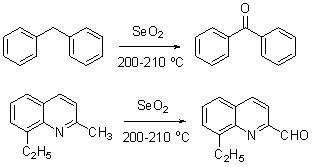 |
Scheme 6 |
1.4.1.3 Preparation of α,β-Unsaturated Carbonyl Compounds
The reaction involves α selenylation of carbonyl compounds followed by oxidation of selenium with peroxides or peracids and subsequent elimination provides the desired α,β-unsaturated carbonyl compounds (Scheme 7).
 |
 |
Scheme 7 |