1.4.1 Selenium Dioxide
Selenium dioxide (SeO2) is a colorless crystalline solid. It is soluble in solvents like dioxane, ethanol, acetic acid and acetic anhydride. It is extremely poisonous and should be carefully handled while working with it. However, it is very selective oxidant.
William J. Hoekstra, Encyclopedia of Reagents for Organic Synthesis, John Wiely and Sons Inc., L. A. Paquette, Ed., New York, 1995, 6, 4437. |
1.4.1.1 Allylic Oxidation
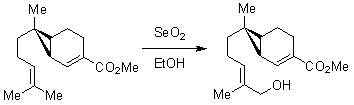
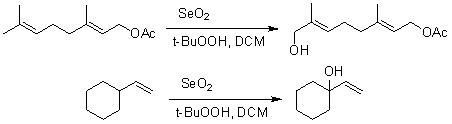
Allylic oxidation is an important organic transformation because it provides a direct access to the allylic alcohols from the readily available alkenes (Scheme 1). SeO2 is found to be an effective reagent for this transformation. The stoichiometric as well as catalytic amount of SeO2 can be used but the later requires an oxidant such as t-BuOOH to reoxidize the reduced selenium(II) to SeO2. The reactivity order in ethanol solvent is as follows CH2 > CH3 > CH but the order may change depending on the reaction conditions.
 |
 |
Scheme 1 |
Mechanism
The reaction proceeds via ene reaction of allylic compounds with SeO2 to afford allylic seleninic acid that undergoes
[2,3]-
sigmatropic rearrangement to give selenium ester, which on hydrolysis gives the desired alcohol (Scheme 2).
 |
Scheme 2 |
1.4.1.2 Oxidation of Carbonyl Compounds (Riley Oxidation)
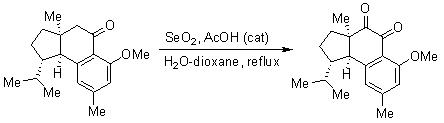
SeO2 oxidizes active methylene or methyl group present adjacent to the carbonyl group to give 1,2-dicarbonyl compounds (Scheme 3). This reaction is called Riley oxidation. It has been widely used for the synthesis of natural products and biologically active compounds.
 |
 |
Scheme 3 |