9.1.3 The Characteristics of Free radical Reactions
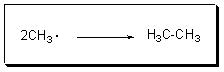
Free radical reactions may be broadly classified into two groups. In the first, the product formation occurs from the combination of two radicals.
In the second class, the product formation results from the reaction of a radical with a molecule by chain process.
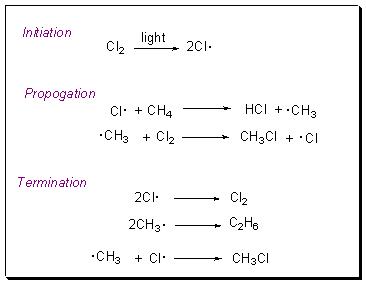
9.2 Formation of Carbon-Halogen Bonds
9.2.1 Substitution in Saturated Carbons
9.2.1.1 Energetics
Radical catalyzed chlorination and bromination can be performed both in gas and liquid phases. The energetic comparison of chlorination, bromination and iodination of methane follows:
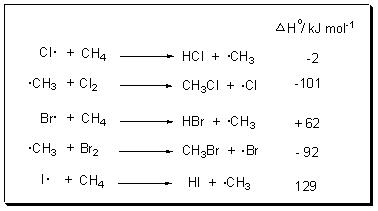
As we can see, in chlorination, both the propagating steps are exothermic reactions. Thus, the chain reaction competes very effectively with the termination steps and the chains are long.
In contrast, in bromination, the first of the propagating steps is endothermic and its activation energy is essentially at least as great as 62 kJ mol -1 . Thus, the reaction is slower than compared to chlorination. As a result, the terminating process competes with the propagating step that leads to the chains short.
In iodination, the reaction is strongly endothermic (129 kJ mol -1 ) that lead to ineffective. In the case of fluorination, both the propagating steps are exothermic that leads to violent reaction with fragmentation of the alkyl groups. Thus, fluorination is usually carried out by other methods.