Allylic and benzylic C-H bonds are weaker than those of saturated systems and exhibit greater reactivity and selectivity with free radicals.
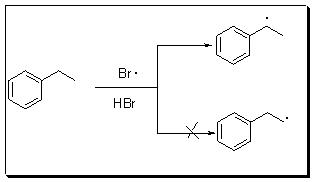
Secondly, polar effect is also operative in radical reactions. For example, the relative reactivity of C-H bonds in butyl chloride towards chlorine atom follows:
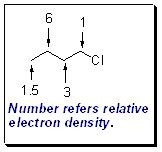
Chlorine atom is electronegative and preferentially reacts at C-H bonds of relatively high electron density.
In contrast, alkyl radicals which are called nucleophilic radicals react preferentially at C-H bonds with electron density low.