9.1 Principles
Free radicals may be defined as the species that contain one or more unpaired electrons. They are generally less stable and react in fraction of seconds with another species.
9.1.1 Formation of Free Radicals
Three general methods are used for the generation of free radicals.
9.1.1.1 Thermal Generation
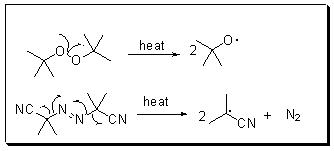
Two types of compounds dissociate to give free-radicals at moderate temperature: (i) compounds that have an intrinsically weak bond such as dialkyl peroixides (DO-O = 155 KJ mol -1 ), and (ii) compounds that, on fragmentation, form strongly bonded products, such as AIBN which releases N2 .
9.1.1.2 Photochemical Generation
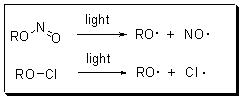
Light can bring the fragmentation of a compound if the wavelength of the light is correspond both to an energy greater than that of the bond to be cleaved, and to an electronic excitation of the molecule concerned. This procedure is suitable for the formation of alkoxy radicals from alkyl nitrite or hypochlorites.