4.4 Substitution by Nuclophilic Nitrogen at Unsaturated Carbon
These reactions are analogous to the base-catalyzed hydrolysis of the carbonyl compounds. The order of reactivity of the compounds having different leaving groups is: acid halide > anhydride > ester > amide.
4.4.1 Reactions of Ammonia and Amines
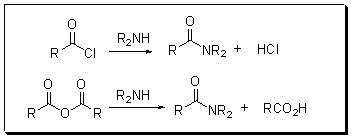
- • Amines readily react with acylating agents such as acid chlorides and acid anhydrides in the presence of base to give amides. These are the general practical methods used for the acylation reactions.
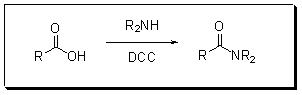
- • The condensation of carboxylic acid with amines using DCC is also a popular route for the amide formation which will be discussed in the section on peptide synthesis. DCC is converted into urea which can be separated by filtration.
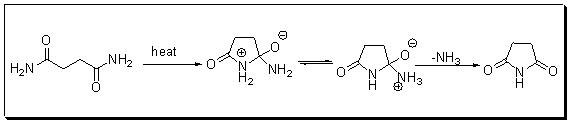
- • Amides are weak nucleophiles and the further acylation occurs very slowly that leads to isolation of the monoacylated product. However, intramolecular displacement can take place if a five or six membered ring formation is possible. For example, heating of the acyclic diamide of succinic acid affords succinimide in good yield.
- •
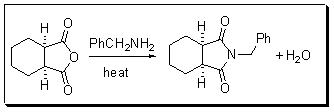
- Cyclic imides can be easily prepared (practical method) by heating a mixture of acid anhydride and amine.
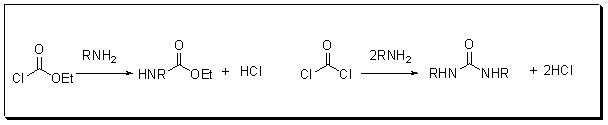
- • The reaction of amines with ethyl chloroformate and carbonyl chloride affords urethanes and ureas, respectively.