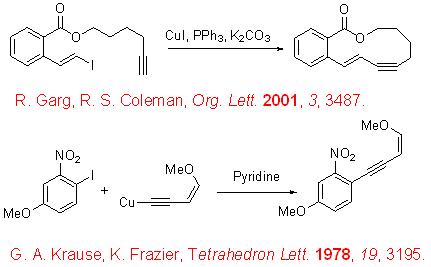
Examples:
3.6 Organomercury Reagents
Organomercury reagents are usually prepared by the metal exchange reaction between mercury(II) salt and Grignard reagent or organolithium. Organomercury compounds have a significant degree of covalency in Hg-C bond. Hence, they are less effective as nucleophiles compared to Grignard reagent or organolithium. Thus, they do not react with aldehydes or ketones but they react with acid chlorides in the presence of a Lewis acid (Scheme 19). The most significant reaction involving an organomercury reagent is oxymercuration-demercuration protocol for hydroxylation of alkenes (Scheme 20). Unlike hydroboration, this reaction follows Markovnikov's principle. Another application of these reagents includes Hoffman-Sands reaction where an alkene can be converted to monobrominated alkanes (Scheme 21).
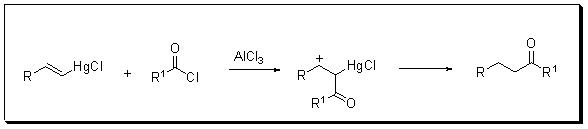
Scheme 19
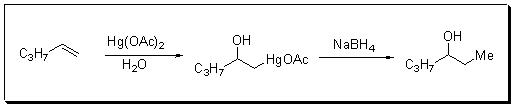
Scheme 20

Scheme 21
TRIVIA Organomercury compounds are extremely poisonous. They are readily absorbed through skin and attack the central nervous system causing severe neurological problems. The Minamata disease in Japan was caused by the release of methyl mercury wastes into the Minamata Bay which accumulated in fish which were then consumed by humans in the region. |