3.5 Organocopper Reagents
The pioneering work from the Gilman group in 1936 marked the beginning of the era of organocopper reagents, describing the preparation of mono-organocopper reagents and their considerable synthetic potential in organic chemistry. The use of copper salts as catalysts in organometallic reactions has then been become popular. The observation that catalytic amounts of copper halides favored 1,4-addition over the usually observed 1,2-addition in the reaction between Grignard reagents and α, β -unsaturated ketones was of crucial importance for the further development of organocopper reagents as synthetic tools in organic chemistry (Scheme 1).

Scheme 1
Preparation
Organocopper reagents can be prepared by transmetallating the Grignard or organolithium reagent (Scheme 2).
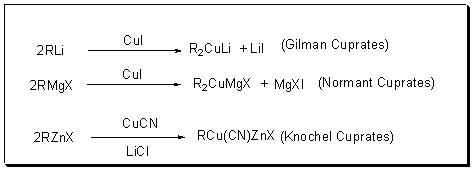
Scheme 2
3.5.1 Reactions with Alkyl or Aryl or vinyl Halides and Tosylates
Alkyl, aryl or vinyl halides and tosylates react with organocuprates to give cross-coupled products (Scheme 3). The method affords an effective route for the synthesis of hydrocarbon from two different alkyl, aryl or vinyl halides.
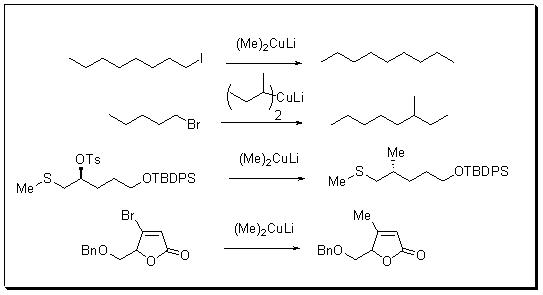
Scheme 3
Mechanism
The reaction takes place via oxidative addition followed by reductive elimination (Scheme 4).
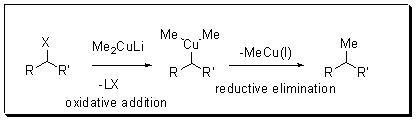
Scheme 4