The product yield is usually low in acid-catalyzed reaction compared to that of the base-catalyzed reactions. However, in some instances the products are different, where the acid-catalyzed reactions are useful. For an example, the base-catalyzed reaction of benzaldehyde with butanone gives A as a main product whereas the acid-catalyzed reaction affords B as the major product.
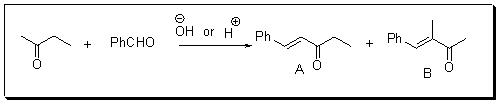
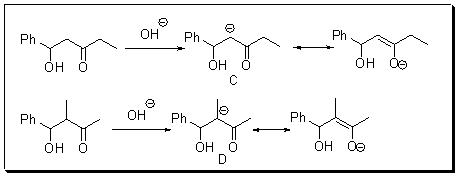
This is because, in the former, equilibria are established with the two possible aldol adducts and the main product is determined by the ease of dehydration to provide an aryl-conjugated product. Thus, the formation of A is favoured since the enolate C is generated faster compared to that of the more substitute enolate D.
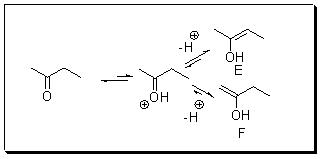
In contrast, in acid-catalyzed reaction the crucial step is not dehydration but the formation of the new C-C bond and the regioselectivity is governed by the rapid formation of the more substituted enol E compared to monoalkylated enol F. Thus, the formation of B is favoured compared to that of A.
Finally, some aldehydes give cyclic polymers with acids. For example, acetal with trace of concentrated sulphuric acid provides the cyclic trimer, paraldehyde, and some of the cyclic tetramer, metaldehyde.

It is reversible and the aldehyde can be generated prior to use by warming with dilute acid. In case of ketones, acetone undergoes similar kind of polymerization with concentrated sulfuric acid producing 1,3,5-trimethylbenzene.