2.3 Reactions of Aldehydes and Ketones
The acid-catalyzed reactions of aldehydes and ketones can be broadly divided into four types: self-condensation, crossed-condensation, reactions of ketones with acid chlorides and acid anhydrides and reactions of 2-methyl pyridines and related compounds.
2.3.1 Self-Condensation
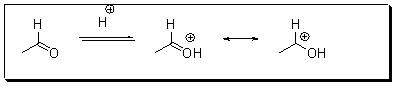
Aldehydes and ketones which are prone to undergo enolization proceed self-condensation in the presence of acids. The acid has dual functions: first, it enhances the reactivity of the carbonyl group towards the addition of a nucleophile, e.g.
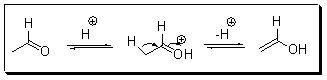
Next, it catalyzes the enol formation of the carbonyl compound, e.g.
A molecule of enol then reacts with a molecule of the activated carbonyl compound.
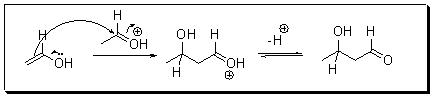
Dehydration via the enol generally follows:

In case of ketones having α -hydrogen, further reaction possible. For an example, in presence of hydrogen chloride, acetone proceeds reaction to afford a mixture of mono- and di-condensation products.
