2.2 Self-Condensation of Alkenes
Alkenes undergo protonation with acid to give a carbocation that can add with second molecule of alkene to generate new carbocation which could eliminate a proton to give alkene. For an example, isobutylene with 60% sulfuric acid affords a 4:1 mixture of 2,4,4-trimethyl-1-pentene and 2,4,4-trimethyl-2-pentene. The reaction takes place by protonation of one molecule of the alkene to provide a carbocation that adds to the methylene group (Markonovkov's rule) of a second molecule. The new carbocation eliminates a proton to afford the products.

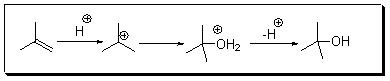
The reaction condition is crucial for the selectivity of the products. For an example, when dilute sulfuric acid is used, the first carbocation undergoes reaction preferentially with water to afford t-butanol as a major product.
Alternatively, when more concentrated sulfuric acid is used, the second carbocation reacts with a further molecule of isobutylene to lead polymerization.
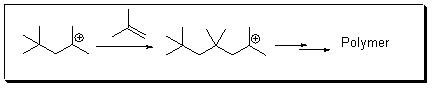
Furthermore, isooctane (used as high-octane fuel) is formed in the presence of isobutene. Under these conditions, the carbocation formed by dimerization of isobutylene abstracts hydride ion from isobutane. During the process a new t-butyl carbocation is generated which adds to isobutylene to lead a chain propagation.

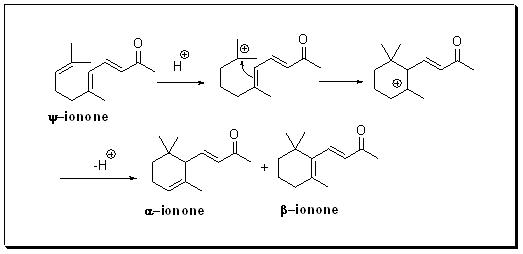
Dienes may undergo acid-catalyzed cyclizations provided the product is a stereochemically favored five or six membered ring. For example, in the presence of acid, ψ-ionone cyclizes to give a mixture of α - and β -ionones.