3.5.6.4 Hydroformylation
One of the most industrially important reactions using cobalt is definitely the hydroformylation. This reaction catalyzed by dicobalt octacarbonyl. This reaction inserts a carbonyl group in an alkene thereby giving rise to aldehydes (Scheme 8). It is also known as the oxo process.

Scheme 8
Both the linear isomer (usually referred as n -product) and the branched isomer (iso -product) are produced. The ratio of the two isomers is crucial for industry as the linear aldehydes are usually important from their perspective. The formation of the two isomers is outlined in the mechanism shown in Scheme 9. At a very high pressure (~ 100 bar), dicobalt octacarbonyl reacts with hydrogen gas to form tetracarbonylhydridocobalt(I). This complex loses one CO molecule to form a coordinatively unsaturated complex which then undergoes alkene insertion to give n -alkyl complex (Markwonikov addition) as well as a branched alkyl complex ( anti- Markwonikov addition). Both these complexes now undergo migratory insertion of CO to generate acyl complexes which then undergo attack by hydrogen to yield the target aldehydes. The use of bulky ligands like PBu3 diminishes the extent of branched aldehyde formation and improves the n/iso ratio.
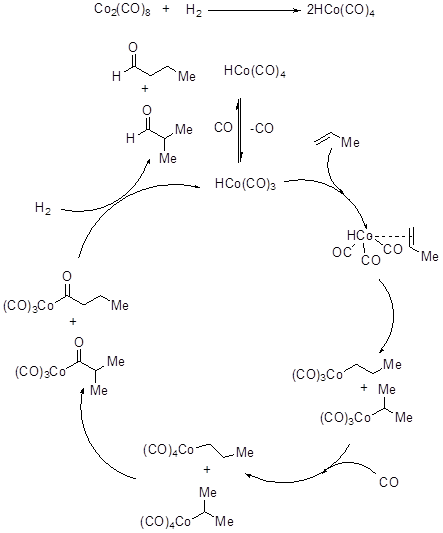
Scheme 9