3.5.6.2 Pauson-Khand Reaction
Dicobalt octacarbonyl, the predominant cobalt carbonyl complex, has found wide applications in organic synthesis. It is prepared by the high pressure carbonylation of cobalt(II) salts. In solution it exists in equilibirium between two forms, both of which obey to the 18 electron rule (Scheme 4).
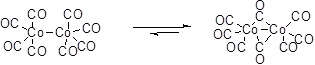
Scheme 4
The reactions of dicobalt octacarbonyl involve insertion of CO into the substrate resulting in carbonylation as the overall result. The reaction of an alkyne with this complex result in the formation of stable organocobalt complex that exists as a tetrahedral cluster(I). This cluster can react with an alkene on heating to generate a cyclopentanone derivative via a [2+2+1] cycloaddition. This reaction is known as Pauson-Khand reaction. It is believed to involve loss of a CO molecule from the tetrahedral complex followed by coordination with the alkene which inserts itself in the Co-CO bond. This intermediate(III) undergoes insertion reaction where CO insertion takes place between the Co-alkene bond forming the intermediate(IV) which may undergo reductive elimination to give the product (Scheme 5).
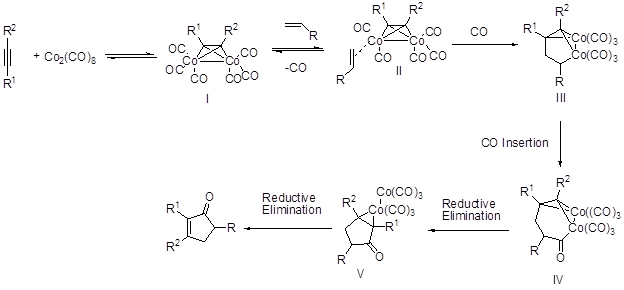
Scheme 5