History
- First studies on rain chemistry were conducted in late 1800s, but modern investigations date back to 1960s.
- Nowadays the chemistry of atmospheric precipitation is fairly well known.
- The phenomenon of acid rain has been known and studied from 1950s.
- 1960 – lowered fish production in Scandinavian lakes
- In 1972 it became an international public policy issue at the first United Nations Conference on the Environment held in Stockholm.
- The transboundary effect of atmospheric pollution has been officially accepted, based on the fact that sulphur and nitrogen oxides are commonly emitted in one location while the acid deposition occurs in distant area.
- In Sweden and Norway around 90% of the acid deposition comes from other countries, primarily UK, Germany, Poland and other Central Europe countriess. Canada receives major acid contribution from the US.
- Rain that is more acidic than normal because it contains sulfuric acid or nitric acid
- result of SOx, NOx, acidic particulates in air
- involves all forms of acid deposition, even if rain is not involved
- Utility plants contribute to 70% SO2 production and 30% NOx production in USA Coal contains as high as 5% sulfur
Mechanism of acid rain
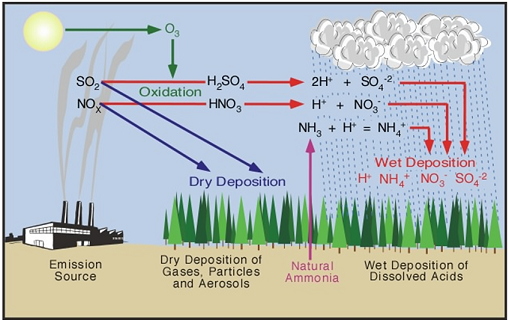
Acid Deposition Formation
Acid deposition can form as a result of two processes. In some cases, hydrochloric acid can be expelled directly into the atmosphere. More commonly it is due to secondary pollutants that form from the oxidation of nitrogen oxides (NOx) or sulfur dioxide (SO2) gases that are released into the atmosphere. Reactions at the Earth's surface or within the atmosphere can convert these pollutants into nitric acid or sulfuric acid. The process of altering these gases into their acid counterparts can take several days, and during this time these pollutants can be transported hundreds of kilometers from their original source. Acid precipitation formation can also take place at the Earth's surface when nitrogen oxides and sulfur dioxide settle on the landscape and interact with dew or frost.
Emissions of sulfur dioxide are responsible for 60-70% of the acid deposition that occurs globally. More than 90% of the sulfur in the atmosphere is of human origin. The main sources of sulfur include:
- Coal burning - coal typically contains 2-3% sulfur so when it is burned sulfur dioxide is liberated.
- The smelting of metal sulfide ores to obtain the pure metals. Metals such as zinc, nickel, and copper are all commonly obtained in this manner.
- Volcanic eruptions - although this is not a widespread problem, a volcanic eruption can add a lot of sulfur to the atmosphere in a regional area.
- Organic decay.
- Ocean spray.
After being released into the atmosphere, sulfur dioxide can either be deposited on the Earth's surface in the form of dry deposition or it can undergo the following reactions to produce acids that are incorporated into the products of wet deposition.
SO2 + H2O → H2SO3
H2SO3 + 1/2O2→ H2SO4