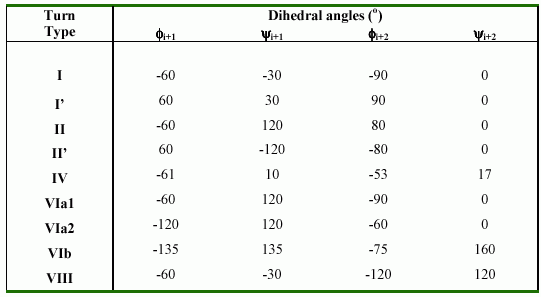
Table2: The nine beta-turn types with their dihedral angles.
2.6.3. β-Turn Peptidomimetics
Turns are important targets for mimicry, both because they serve as recognition sites in peptides and proteins and because they allow a protein chain to fold back upon it to form a compact structure. One area of research has focused upon the creation of structures that mimic the conformations and functionality displayed by β-turns and related structures, whereas a second has focused upon the creation of ‘nucleating turn mimics’ that induce structure in attached groups (typically peptide strands).
Cyclic structures were first used as turn mimics and nucleators in the mid-1980s and continue to be used for these purposes. Gennari, Scolastico and co-workers have investigated bicyclic lactams 2.01 and 2.02 (Figure 2.43) as turn mimics and have established that 2.01 nucleates b-sheet structure when incorporated into certain peptides. Kelly and co-workers have used dibenzofuran turn unit 2.03 (Figure 2.43) to nucleate anti-parallel β-sheets in water. These compounds adopt conformations in which the dibenzofuran moiety folds against the sheet, forming a hydrophobic cluster with the side chains of the first residues of the sheet, thus stabilizing the turn. Recently, Kelly and co-workers reported a dibenzofuran turn unit that aligns two peptide strands to form a parallel β-sheet-like structure (2.03). Soth and Nowick have reported peptide/oligourea/azapeptide hybrid oligomer 2.04 (2.43), which adopts a hairpin turn containing two intramolecular hydrogen bonds in chloroform solution. Two separate groups have reported using a cis-norbornenyl turn that induces β-sheet-like structure in attached peptides. Smith, Hirschmann et al. have extended earlier work on the use of 3,5-linked pyrrolin-4-one β-strand mimics to create a hydrogen-bonded turn-like structure.
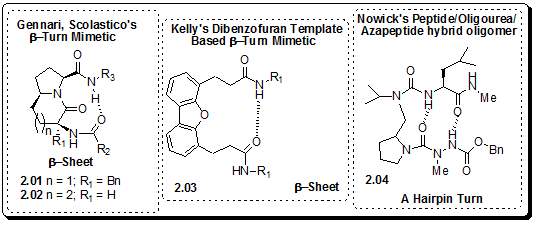
Figure 2.43: β-turn mimics that nucleate sheet or hairpin structure
The acyclic structures containing alkenes have been developed, which exploit allylic strain and other acyclic conformational effects to mimic β-turns. In these compounds, the alkene unit mimics the amide bond that would be present in a natural turn. Gellman and co-workers presented the first example of this strategy is alkene-based turn 2.05 (Figure 2.44). A longer peptidomimetic (2.06), with amino acids flanking the alkene-based turn, prefers a hairpin conformation in dichloromethane solution. Careful NMR studies suggest that other competing conformations are also present. Wipf et al. have designed and synthesized related alkene-based turns 2.07 and 2.08 (2.44); the latter contains a trifluoromethyl-substituted alkene, which mimics the electronic properties of the amide group.
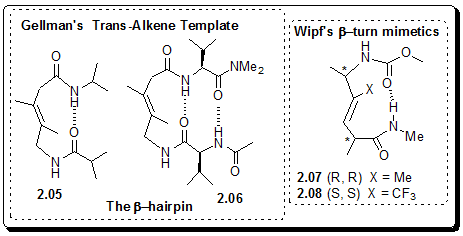
Figure 2.44: β-turn mimics that nucleate sheet or hairpin structure
A new development in the creation of turn structures involves β-peptides. Gellman and co-workers have developed a heterochiral nipecotic acid dimer turn (2.09) that induces sheet structure in attached β-peptide strands. Incorporation of 2.09 into β-tetra peptide 2.10 (Figure 2.45), resulted in the formation of the β-peptide equivalent of a β-hairpin. This work is particularly exciting because it suggests that different types of b-amino acids can be used to create secondary structures in a predictable fashion. Seebach et al. have also created a β-peptide turn (2.11) based on the central turn of their 12/10/12 helix (Figure 2.46). This turn comprises two homochiral β-amino acids, the first with a substituent at the α-position, the second with a substituent at the β-position. Seebach et al. have also reported an α, α-disubstituted β-tripeptide that forms a similar turn. This result, demonstrates that the structures of β-peptides are substituent dependent and suggests rules for designing secondary structures.