Force due to pressure p1 at End 1- Force due to pressure p2 at End 2 - Resistance exerted by the diaphragm - Viscous frictional force exerted by the capillary liquid = Mass of capillary liquid x Acceleration of capillary liquid towards the direction of motion
We consider the capillary liquid to be incompressible so that the displacement of capillary liquid is same as the displacement of diaphragm. Now the above force balance can be expressed through the following equation:
 |
(VII.7) |
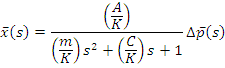
where A= cross-sectional area of the capillary tube, K= Hooke's constant of diaphragm which acts like a spring, x= displacement of diaphragm/capillary liquid, C= damping coefficient of capillary liquid.
Rearranging the above, we obtain
 |
(VII.8) |
In Laplace domain,
 |
(VII.9) |
The value of x is linearly transduced to electrical signal that indicates the actual measurement variable. Hence the output of DP cell maps a second order behavior with the differential pressure.