VII.5.2.1 Differential Pressure Cell
The differential pressure cell (DPC) measures the difference between two or more pressures introduced as inputs to its sensing unit. The sensing unit consists of a diaphragm and a pressure cavity to create a variable capacitor which detects strain due to applied pressure. The following figure presents a schematic of the sensing unit of the DPC.
Fig. VII.17: Schematic of a Differential Pressure Cell |
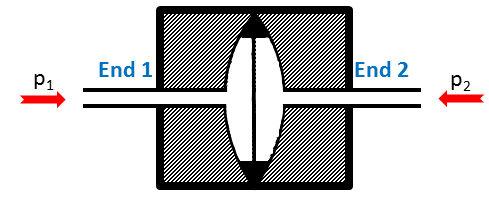
The cell contains two compartments separated by a diaphragm. The differential pressure acting on the diaphragm, due to pressures exerted on its two sides, results in displacement of the diaphragm. This displacement of diaphragm is transduced to electrical signal which is transmitted and recorded through appropriate instrumentation. The displacement of diaphragm is usually linearly calibrated to the differential pressure acting on it. The ends of the DPC are capillary tubes. Compartment is filled with some liquid ( e.g . silicone oil) of mass m. The ends are connected to processing units of which the differential pressure needs to be measured. Often the End 2 is left open to the atmosphere when the pressure at only one end needs to be measured. The following force balance will be in place: