Hence,
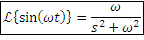 |
(III.9) |
Delayed function : , i.e .f(t) is delayed by
  seconds
 |
(III.10) |
Now, let us take  , hence
  . At
. At  and at
  . Thus,
 |
(III.11) |
Hence,
 |
(III.12) |
Pulse function : See Fig. III.1(c) for the schematic of an unit pulse function. The area under the pulse is 1. The duration of pulse is T and hence it achieves maximum intensity of  . Thus the function is defined by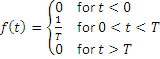
It can also be defined as the “addition” of two step functions
which are equal but with opposite intensity, however, the second function is delayed by T .

Hence, it is evident that  is equal to
  in intensity however it is delayed by time
Thus,  . Since
  is a step function of intensity , the following expression will hold.
