III.1 Laplace Transform
Laplace Transform enables one to get a very simple and elegant method of solving linear differential equation by transforming them into algebraic equations. It is well known that chemical processes are mathematically represented through a set of differential equations involving derivatives of process states. Analytical solution of such mathematical models in time domain is not only difficult but sometimes impossible without taking the help of numerical techniques. Laplace Transform comes as a good aid in this situation. For this reason, Laplace Transform has been included in the text of this “Process Control” course material though it is purely a mathematical subject.
III.1.1 Definition of Laplace Transform
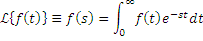
Consider a function f(t). The Laplace transform of the function is represented by f(s) and defined by the following expression:
 |
( III.1 ) |
Hence, the Laplace Transform is a transformation of a function from the t -domain (time domain) to s -domain (Laplace domain) where both t and s are independent variables.
III.1.2 Properties of Laplace Transform
• The variable s is defined in the complex plane as  where
where  .
.
• Laplace Transform of a function exists if the integral 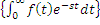 has a finite value, i.e. , it remains bounded; eg . if
  , then f(s) exists only for
  , as the integral becomes unbounded for
  .
.
• Laplace Transform is a linear operation.
