So it is maxima, where the insulation radius is equal to

where, rc denotes the critical radius of the insulation. The heat dissipation is maximum at rc which is the result of the previously mentioned opposing effects.
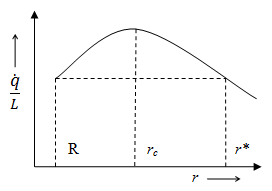
Fig. 3.12: The critical insulation thickness of the pipe insulator
Therefore, the heat dissipation from a pipe increases by the addition of the insulation. However, above rc the heat dissipation reduces. The same is shown in fig. 3.12.
The careful analysis of the rc reveals that it is a fixed quantity determined by the thermal properties of the insulator. If R <rc , then the initial addition of insulation will increase the heat loss until r =rc and after which it begins to decrease. The same heat dissipation which was at bare pipe radius is again attained at r*. The critical insulation thickness may not always exist for an insulated pipe, if the values of k and h are such that the ratio k/h turns out to be less than R.
It is clear from the above discussion that the insulation above rc reduces the heat dissipation from the cylindrical surface. However, if we keep on increasing the insulation the cost of insulation also increases. Thus again there are two opposing factors that must be considered to obtain the optimum thickness. It should be calculated that what is the pay-back period, that is in how many years the cost of insulation is recovered by the cost of energy saving.
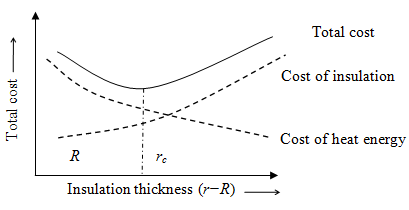
Fig. 3.13: Optimum insulation thickness
The optimum insulation thickness (fig. 3.13) can be determined at which the sum of the insulation cost and the cost of the heat loss is minimum.