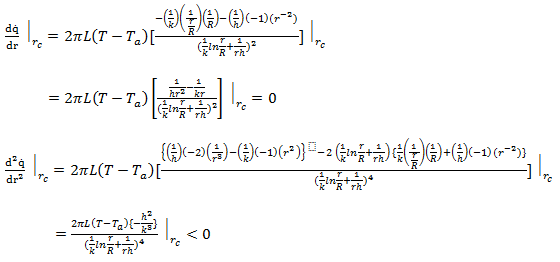
Let us consider a thick insulation layer which is installed around a cylindrical pipe as shown in fig. 3.10 (equivalent electrical circuit is shownin figure 3.11). Let the pipe radius be R and the insulation radius is r. This (r-R) will represent the thickness of the insulation. If the fluid carried by the pipe is at a temperature T and the ambient temperature is Ta. The insulation of the pipe will alter pipe surface temperature T in the radial direction. That is the temperature of the inner surface of the pipe and the outer surface (below insulation) of the pipe will be different. However, if the thermal resistance offered by the pipe is negligible, it can be considered that the temperature (T) is same across the pipe wall thickness and it is a common insulation case (please refer previous discussion). It can also be assumed that the heat transfer coefficient inside the pipe is very high as compared to the heat transfer coefficient at the outside of the insulated pipe. Therefore, only two major resistances in series will be available (insulation layer and gas film of the ambient).
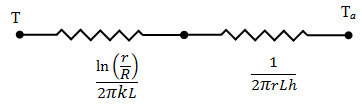
Fig.3.11: Resistance offered by the insulation and ambient gas film
Therefore,
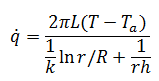
where, k is the thermal conductivity of the material.
On differentiating above equation with respect to r will show that the heat dissipation  reaches a maximum,