3.4 Thermal insulation
We have seen how heat transfer is important in various situations. Previous discussion indicates that we are all the time interested in the flow of the heat from one point to another point. However, there are many systems; in fact it is a part of the system, in which we are interested to minimize the losses through heat transfer. For example, in a furnace we want to have high heat transfer inside the furnace; however we do not want any heat loss through the furnace wall. Thus to prevent the heat transfer from the furnace to the atmosphere a bad heat conductor or a very good heat insulator is required. In case of furnace the wall is prepared by multiple layers of refractory materials to minimize the heat losses. Therefore, wall insulation is required in various process equipment, reactors, pipelines etc. to minimize the heat loss from the system to the environment or heat gain from the environment to the system (like cryogenic systems). However, there are situations in which we want to maximize the losses for example, insulation to electric wires.
The petroleum conservation research association (PCRA) provides a good database on the properties and applications of industrial thermal insulations (http://www.pcra.org/English/education/literature.htm). The table 3.2 shows some common insulations used in chemical process industries for various process equipment and pipelines.
Table-3.2: Thermal properties of a few of the insulations being used in the chemical process industries
Material |
Temperature |
Approximate thermal |
Density |
| Asbestos | -200 to 0 | 0.074 | 469 |
| Glass wool | −7 to 38 38 to 93 |
0.031 0.041 |
64 64 |
| Fibre insulating board | 21 | 0.049 | 237 |
| Hard rubber | 0 | 0.151 | 2000 |
| Polyurethane foam | −170 to 110 | 0.018 | 32 |
An interesting application of the heat loss from a surface of some practical significance is found in the case of insulation of cylindrical surfaces like small pipes or electrical wires. In many a cases we desire to examine the variation in heat loss from the pipe with the change in insulation thickness, assuming that the length of the pipe is fixed. As insulation is added to the pipe, the outer exposed surface temperature will decrease, but at the same time the surface area available to the convective heat dissipation will increase. Therefore, it would be interesting to study these opposing effects.
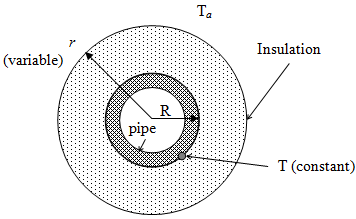
Fig. 3.10: Heat dissipation from an insulated pipe