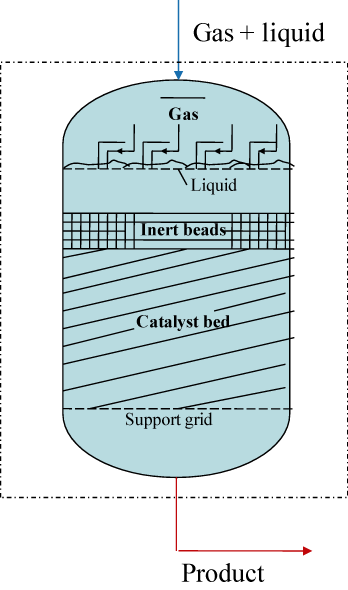
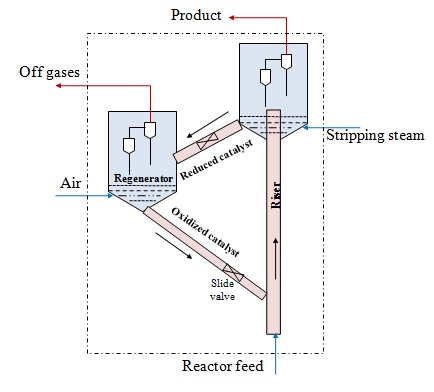
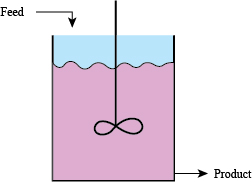
A pictorial representation of various unit processes and operations that are often encountered in chemical process flowsheets is presented in Table 0.2. Along with these figures, their function role in the process technology is also presented.
| Process Technology | Functional Role |
Reactors |
- Central and most important process technology in process flow - Carry out desired reactive transformations |
a) CSTR
CSTR |
- Well mixed reaction system - Homogenous liquid/gas phase reaction - Most easy configuration - Temperature control through Jacket - Reactant instantaneously reaches lowest concentration -Mostinexpensive to design and operate |
|
- Has a simple design, with the requirement of very little - Ideal for small scale experimental studies on reactor kinetics - Can be used industrially for treatment of very small quantitiesof materials. |
c) PFR  |
- Homogenous liquid/gas phase reaction |
d) Packed Bed Reactor (PBR) 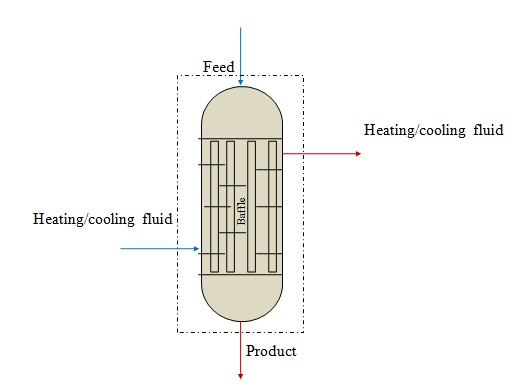 |
- Hetero------geneous reaction |
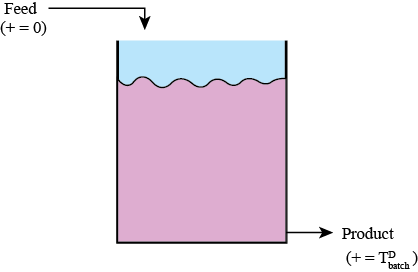
e) Trickle Bed Reactor
|
- Multi-phase reaction - If the reaction is not catalytic, packing serves to enhance interfacial area - If the reaction is catalytic, packing acts as a catalyst as well - Complicated design |
f) Fluidized bed reactor |
- Provides highest mass, heat and hence reaction rates for solid-fluid reactions - Very commonly deployed in petroleum refineries (catalytic cracking) - Complicated accessories (shown) and control system required - The accessories are for catalyst re-generation and transport. |