The load may, therefore be considered as acting at a distance 2/3 from the bottom of the vessel.
Load, F = ScW (6.16)
Where, W = weight of the vessel
Sc = seismic coefficient
Seismic coefficient depends on the intensity and period of vibrations. For example if the vibration lasts for more than one second seismic coefficient value varies from minimum, moderate to maximum Sc=0.02, 0.04, and 0.08 respectively.
Stress induced due to bending moment up to height X from the top of the column is given by:
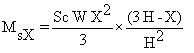 (6.17)
Where X = H, maximum bending moment is at the base of column
Msb = 2/3 × Sc W H (6.18)
The resulting bending stress due to seismic bending moment is given by:
fsb =  (6.19)
The maximum bending moment is located at the base of the vessel (X = H). Thus substituting H for X in Eq. (6.17)
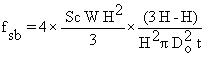 (6.20)
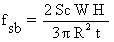 (6.21)
The possibility of the wind load and seismic load acting simultaneously over the column is rare. So both the loads are computed separately and whichever is more severe is used to calculate the maximum resultant stress.
Maximum tensile stress at the bottom of the skirt
ftensile = (fwb or fsb ) - fdb
Maximum compressive stress on the skirt
fcompressive = (fwb or fsb ) + fdb , here, fdb - dead load stress
Taking into account the complexity of the final equation for maximum stresses, it is customary to assume a suitable thickness ‘ t ' of the skirt and check for the maximum stresses, which should be less than the permissible stress value of the material.
7. STRESS DUE TO ECCENTRICITY OF LOADS (TENSILE OR COMPRESSIVE)
fe = 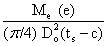 (6.22)
Me = summation of eccentric load
e = eccentricity