6. CENTRIFUGAL SEPARATION
Centrifugal separation is similar to sedimentation, but some forces are added in order to get a better separation. In a centrifugal device, the centrifugal force is generated to increase the force acting on the particles. Utilization of centrifugal action for the separation of materials of different densities and phases, might be built in stationary and rotary types of equipment. In centrifugal separators, centrifugal forces act on particles is several times greater than gravity as it enters a cylindrical separator. This results in a much shorter separation time than could be accomplished solely by gravity. It has mainly been used to separate fluids in static state, i.e. specific volumes, which needed to be separated.
The centrifugal force acting on a particle is :Cf = m w2 r
Where, m – mass of particle; w – angular velocity of the particle; r – radial distance from axis of rotation
The influence of centrifugal force on the particle varies as the particle moves in the separation vessel. The relative centrifugal force can be defined as the force acting upon a particle in a centrifugal field in terms of multiple of its own weight in the gravitational field.
...........................................................(Cf )r ..............................(5.11)
w = 2 π N/60
here, N is revolution per minute
..............................................................(Cf )r = 1.11 × 10⁻⁵ N2 .r.......... (5.12)
here, r is radius from the axis of rotation,
the relative mass of particle or effective mass of particle = V ( ρP – ρf )
V – volume of particle; ρP – density of particle; ρf – density of fluid.
For a spherical particle:  ; dp – particle diameter
The force producing the motion:
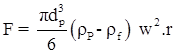 ............................(5.13)
The force resisting the motion of particle: F = 3 
μ- viscosity of liquid; u – velocity of particle
The particle accelerates until it reaches a terminal velocity where the two forces are equal
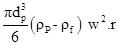 = 3 ...................(5.14)
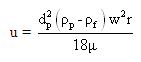 .....................................(5.15)