The reaction A + B → C was carried out over 0.5 wt% Ruthenium supported on Alumina at temperature of 475 K and 5 atm pressure. Hydrogen chemisorption test showed catalyst dispersion to be 49 %. The turn over frequency for C was reported to be 0.044 s-1 . Calculate the rate of formation of C in mol/s.g of catalyst. Atomic weight of Ruthenium = 101.1; Molecular weight of Alumina=101.9, Assume molecular weight of C = 75.
The catalytic reaction A to R proceeds with a second order rate. . The packed bed reactor is operated for twelve days using a steady feed of pure A, one metric ton of catalyst and FA0= 5 kmol/hr at 450°C and 3 atm. The catalyst is slowly deactivated by both A and R and the rate of deactivation is found to be: . Determine the conversions at the beginning and end of the run?
The reaction A + B → C is reversible and external – internal diffusion steps have negligible concentration gradient. Assuming Langmuir Hinshelwood model derive the intrinsic rate if adsorption of B is rate controlling. State the assumptions, if any.
The reaction A + B → C is irreversible and external – internal diffusion steps have negligible concentration gradient. Derive the intrinsic rate if surface reaction is rate controlling. State the assumptions, if any.
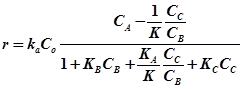
For a solid catalyzed gaseous reaction A + B → C, adsorbed A reacts with adsorbed B and adsorption of A is controlling. The rate is given as
At low pressure, how does initial rate varies with total pressure Pt? Assume the gases to behave ideally.
How effectiveness factor is defined ?
Define Thiele modulas.
How effectiveness factor vary with Thiele modulas.
At what values of Thiele modulas intraparticle resistance is negligible.
Determine the effect of intraparticle mass transfer resistance on the order of a reaction.
Define combine and effective diffusivity.
What kind of diffusions are observed in catalyst pores ?
 . The packed bed reactor is operated for twelve days using a steady feed of pure A, one metric ton of catalyst and FA0= 5 kmol/hr at 450°C and 3 atm. The catalyst is slowly deactivated by both A and R and the rate of deactivation is found to be:
  . Determine the conversions at the beginning and end of the run?