There are several mechanisms of crystal growth and most of these lead to the simple equation of growth rate, 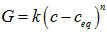 . The ‘k’ is the kinetic coefficient, ‘c’ is the actual concentration and ‘ceq’ is the equilibrium concentration. The exponent ‘n’ is usually only 1-2 and often close to 1.
Hence the dependency of the crystallite growth rate on concentration is closer to a linear function while nucleation rate increases exponentially with concentration. Therefore high super-saturation level promote nucleation rather than crystal growth and favor the precipitation of highly dispersed materials. In contrast precipitation from the more dilute solution tends to produce fewer but larger crystals.
Apart from nucleation and crystal growth, aggregation is also an important step. Aggregation leads to fewer and larger but yet porous particles. It is the formation of clusters of nano-scale primary particles into micrometer scale secondary particles. Physical and chemical forces can hold these particles together. Porosity is then determined by how the particles are stacked and the pores are considered as void spaces between the primary particles. Because of very high super-saturation during the precipitation of most base metal hydroxides or carbonates, nucleation is spontaneous.
Process variation
Precipitation process can be carried out in different ways. The process can be carried out either in batch mode or in continuous mode. The other process variation that affects the precipitate properties is the sequence of addition of the starting materials.
In a batch process, the salt solution from which the metal hydroxide is to be precipitated is taken in a vessel and the precipitating agent is added. The advantage of this method is its simplicity. However, variation of batch composition during precipitation process is a major limitation. This can lead to differences in the properties of the precipitate formed in the initial and final stages. The continuous process involves continual simultaneous addition of salt solution and precipitating agent to a vessel with simultaneous withdrawal of precipitate. This process has a higher demand on process control. All the parameters (pH, temperature, concentration, residence time) can be controlled as desired.
The order of addition of starting materials also affects the final properties of the precipitated catalysts. Different schemes of addition of starting materials in precipitation process is shown in Fig. 2.When metal solution is added to the precipitating agent, the product tend s to be homogeneous since the precipitating agent is present in large excess. This process is particularly important in co-precipitation as it give more homogeneous product than the process where the precipitating agent is added to a mixed metal solution. In the latter case, the hydroxide with lower solubility tends to precipitate first, resulting in formation of non-homogeneous product. Simultaneous addition of both reagents to a buffer solution of constant pH results in better homogeneity and process control. In this process, ratio of metal salt and precipitating agent can be controlled. However, product at the start and at the end may vary due to change in concentration of other ions that are not precipitated. These counter ions tend to occlude in larger extent in final products. Aging is also longer for final products. Aging represent time of formation of coprecipitated and its separation from solution. Aging results in change in structure and properties of hydroxide network. Aging leads to more crosslinked network.