For nucleation to occur the solution must be super saturated with respect to the components which is to be precipitated. Parameters affecting supersaturation is shown in Fig. 1. In supersaturated region the system is unstable and precipitation occurs with any small disturbance. The supersaturaton region is approached either by increasing the concentration through evaporation, lowering the temperature or by increasing pH. The solubility of a component increases with temperature as shown in Fig. 1. The solubility curve is also function of pH. As pH increases solubility decrease and curve shift from 1 to position 2. Then the point which was initially in solution region becomes in supersatured region. The increase in pH is the most convenient method for precipitation. The reaction during precipitation,  , is controlled by increasing the pH through addition of a basic solution. Hence by raising the pH value of a solution by addition of alkaline or ammonium hydroxide the corresponding metallic hydroxide compounds can be made insoluble and precipitated from solution. Commonly used reagents are NaOH, KOH, NH4OH, carbonates and bicarbonates. Particles within supersaturated region develop in two steps : nucleation and growth.
Nucleation may proceed spontaneously through the formation of M(OH)n entities or be initiated with seed materials such as dust, particle fragments, roughness of vessels surface. Addition of seed material enhances rate of nucleation. The nucleus is defined as the smallest solid phase aggregate of atoms, molecule or ions which is formed during a precipitation and which is capable of spontaneous growth. For nucleation to start the solution need to be super saturated. Only when the concentration exceeds a critical threshold value a nucleus will form and the precipitation will begin. As long as the concentration of the species stays above the nucleation threshold, new particles are formed. Nucleation starts with the formation of clusters which are capable of spontaneous growth by the subsequent addition of monomers until a critical size is reached. Cluster smaller than this size tends to re-dissolve, while larger cluster continues to grow. As soon as the concentration falls below the critical concentration due to consumption of the precursors by nucleation or by the growth process, only particle growth of existing particles continues. Growth proceed through adsorption of ions on surface of seeded particle. This growth is a function of concentration, temperature and pH. Rates of nucleation and growth can be independently controlled. If nucleation is faster than growth, the system produces a narrow distribution of small particles. Fast growth results in narrow distribution of large particles.
Several equations are proposed for nucleation rate and the most used is :
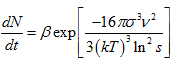
where β is the pre-exponential term, σ is solid –fluid interfacial energy,  is solid molecular volume and T is the temperature. The super saturation ‘s’ is defined as the ratio of actual concentration to solubility; s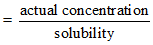
The equation can be simplified as 
Thus nucleation depends strongly both on concentration and temperature. There is a critical super saturation concentration below which nucleation is very slow and above which nucleation is very fast.