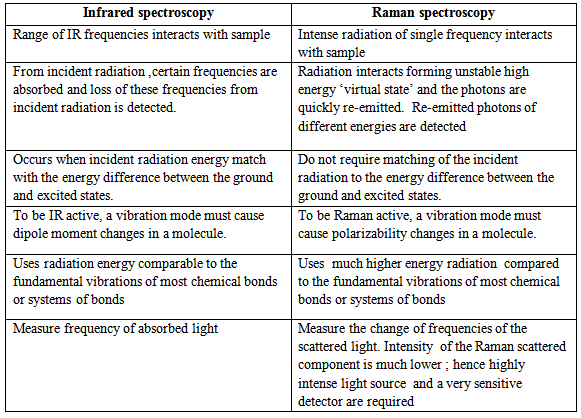
Table 1. Comparison of Infrared absorption and Raman scattering
Selection rule
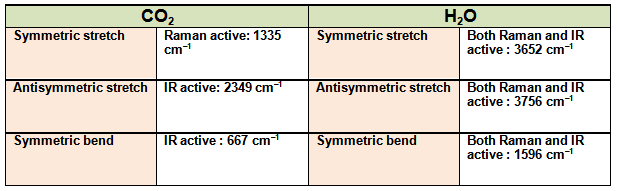
Intense Raman scattering occurs from vibrations which cause a change in the polarizability of the electron cloud around the molecule. Usually, symmetric vibrations cause the largest changes in polarizability and give the greatest scattering. In contrasts for infrared absorption, the most intense absorption is caused by a change in dipole and hence asymmetric vibrations which cause this are the most intense. The two techniques usually give quite different intensity patterns. As a result the two are often complementary and used together to give a better view of the structure of a molecule. In some cases vibrations of a molecule can be both infrared and Raman active. Selection rules related to symmetry is :
- Rule of thumb: symmetric=Raman active, asymmetric=IR active
Table 2. Raman and IR active band of CO2 and H2O molecule
Working principle and instrumentation
A typical Raman system consists of the following basic components:
1) An excitation source, usually a laser
2) Sample illumination system and light collection optics
(3) Double or triple monochromator /Wavelength selector
(4) Signal processing system consisting of a detector, an amplifier, and an output device.
Sample is mounted in the sample chamber and laser light is focused on it with the help of a lens. The scattered light is collected using another lens and is focused at the entrance slit of the monochromator. The width of the monochromator slit is set for the desired spectral resolution. Monochromator effectively rejects stray light and serves as a dispersing element for the incoming radiation. Light leaving the exit slit of the monochromator is collected and focused on the surface of a detector. This optical signal is converted to an electrical signal within the detector. Signal is processed in a computer to develop the final spectrum. Schematic diagram of Raman spectrophotometer is shown in Fig. 2.
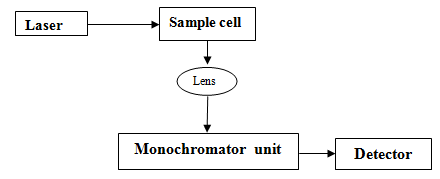
Fig. 2. Schematic diagram of Raman spectrophotometer