Raman spectroscopy
Raman spectroscopy is used to analyze the internal structure of molecules and crystals. It is based on scattering phenomenon of electromagnetic radiation by molecules. Scattering by molecules can be elastic or inelastic.
- Elastic scattering: the scattered light has the same frequency as that of the source radiation. Elastic scattering is called Rayleigh scattering.
- Inelastic scattering: the scattered light has a different frequency from that of the source radiation. Inelastic scattering is called Raman scattering.
Basic process
At room temperature, most molecules are present in the lowest energy vibrational level. When materials is irradiated with intense electromagnetic radiation of single frequency it interacts with the molecule and distort (polarize) the electron cloud around the nuclei to form a short-lived high energy state called ‘virtual state'. Energies of these virtual states are determined by the frequency of the light source used. These high energy virtual states are very unstable.
Raman Stokes scattering : During inelastic (Raman) scattering the molecule return from virtual state to a higher energy level compared to the initial stage (Fig. 1c). A fraction of photon energy is absorbed by the molecules to remain in the higher energy vibrational state V=1 where EV=1 > EV=0 and EV=0 is the ground vibrational state. Consequently energy of the reradiated photon is less than that of incident photon. This type of inelastic scattering is called Stokes scattering.
Raman anti-stokes scattering : Due to thermal energy, some molecules may be present initially in the excited state V=1. If after interaction with the incident light, the molecules from virtual state return to ground state V=0 then the energy of the reradiated photon will increase by the amount of ΔE = EV=1 - EV=0 as shown in Fig. 1a. This type of Raman scattering is called anti-stokes scattering and involves transfer of energy to the scattered photon.
When the electrons excited from ground energy level returns back to ground state V=0 then it corresponds to Rayleigh scattering (Fig. 1b)
Relative intensities of stokes & anti-stokes scattering
Relative intensities of these two processes depend on the population of the various states of the molecule. At room temperature majority of molecules are expected to be initially in ground energy state and excited vibrational state will be small. Consequently anti-stokes scattering will be weak compared to stokes scattering. Usually in Raman scattering stokes scattering is recorded. As temperature rises anti-stokes scattering will increase relative to stokes scattering.
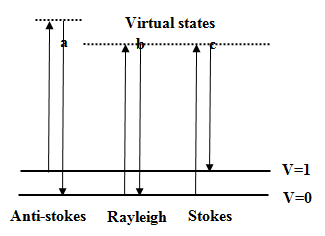
Fig. 1. Different transitions observed in Raman process
Raman Activity
To be Raman active, a vibration mode must cause polarizability changes in a molecule. Mathematically, Raman activity requires that the first derivative of polarizability (α) with respect to vibration at the equilibrium position is not zero.
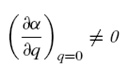
The ‘q' is the displacement of the atoms form equilibrium position. Polarization of molecules varies with direction in a three-dimensional space. For example, in a linear molecule such as CO2, the electron cloud has the shape of an elongated ellipsoid that is more deformable along its long axis than the directions perpendicular to the long axis.
Generally, if the ellipsoid changes its size, shape and orientation with vibration, that vibration is Raman active. For example in case of H2O molecule, all normal mode vibrations as shown in Fig.1a are Raman active because the ellipsoid changes size, shape or orientation in all cases.