Capillary (pore) condensation and evaporation: Kelvin equation
As discussed in the previous section, for porous solids, the desorption curve lies above the adsorption curve from  to some intermediate value resulting in a hysteresis loop. This phenomenon occurs due to capillary condensation – evaporation process. It was recognized by Kelvin that the vapor pressure of a liquid contained in a small diameter capillary is less than the normal value predicted for a free surface.
Consider a capillary filled with a liquid of surface tension σ. The change in free energy due to evaporation of a differential volume of liquid ‘dv' is nΔG ,where  . Here υmol is the molar volume. Now,

 -------[4]
Again , 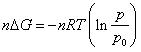 --------[5]
Equating [4] and [5]
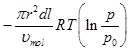
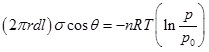 =
= 
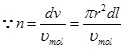
Or , 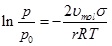 cos θ = 1
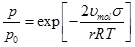
This is the general form of the Kelvin equation assuming wetting angle to be zero. This equation states that the pressure at which condensation or evaporation will occur is always less than the free surface vapor pressure if the capillary radius is small enough for the given liquid. When a nonporous solid or solid containing large pores is subjected to physical adsorption – desorption equilibrium experiments, actual condensation of adsorbate will occur when the gas pressure
equals the vapor pressure at the prevailing temperature that is at . On other hand if pores of appropriate radius exists, condensation will occur before . Thus liquid N2 will form within the pores at  . On adsorption, this would account for the rapid increase in the volume of gas adsorbed with
  , typical of adsorption isotherms of porous solids.
However, this mechanism does not account for the occurrence of hysteresis loop, if filling of pores on adsorption and their emptying on desorption follow the same mechanism. In this physisorption mechanism, pores are assumed to undergo vertical filling and emptying. Therefore, occurrence of hysteresis suggests that filling mechanism of pores is different than the desorption mechanism. Later a different mechanism was forwarded for pore filling by Cohan [1]. It was suggested that during adsorption, the pores may be filling radially instead of vertically. As gas molecules are condensing radially on the surface of pores, the effective radius ‘r' is decreased on condensation of first layers. This causes further condensation at a fixed p/po. In other words pores of a radius ‘r' corresponding to a given p/po, fill instantaneously. In this condition, the change in volume  and that of surface is
  . Kelvin equation can be modified as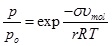
For a given pore radius r, adsorption with radial capillary condensation occurs at 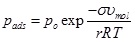
While vertical emptying of the pores occurs during desorption at about
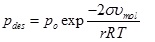
Wetting angle is taken zero. Adsorption pressure related to desorption pressure by 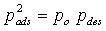 . This implies that the pressure required to empty the capillary is proportional to the square of that necessary to fill it and hence hysteresis.
Book References :
• J.J. Carberry, Chemical and catalytic reaction Engineering, Dover Publications, 2001
• J. M. Thomas & W. J. Thomas, Principles and Practice of Heterogeneous Catalysis, VCH, 1997
• J. M. Smith, Chemical Engineering Kinetics, McGraw-Hill Book Company, 1981
• R. J. Farrauto & C. H. Bartholomew, Fundamentals of Industrial catalytic Processes, Blackie Academic & Professional, 1997
• D.M. Ruthven, Principle of adsorption & adsorption processes, John Wiley & sons, 1984.
Journal reference
- 1. L.H. Cohan, J. Am. Chem. Soc. 60(1938) 433