Reagents:
- PCR thermal cycler
- DNA template
- Forward primer
- Reverse primer
- 2X PCR master mix
- Nuclease free water
- PCR tubes
- Agarose gel electrophoresis apparatus
The reagents required for a complete PCR reaction volume is given in the table.
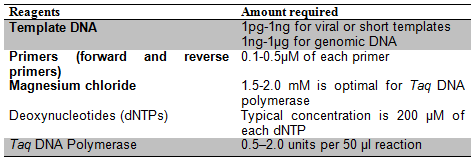
Primers: A primer is a short oligonucleotide that serves as a starting point for DNA synthesis. In PCR, two primers are required to bind to each of the single stranded DNA (obtained after denaturation) flanking the target sequence. These are called Forward and Reverse primers. They primers are designed in such a way that they have a sequence complimentary to the sequence in the template DNA. Two restriction enzymes sites are added at the 5’ end of each of the primer to facilitate cloning. The chosen restriction enzymes will not cut DNA fragment (non-cutters). Typically 3 to 4 nucleotides are added at the end of the restriction sites to allow efficient cutting by restriction enzymes.
Methodology: Colony PCR has three major events (Denaturation, Annealing and Elongation) to complete the amplification process (Figure 40.1). The complete process of colony PCR is as follows-
1. Inoculate single colony into the 100ml LB media and allow the cells to grow at 370C, 180rpm until
OD600 nm reaches to the 0.4-0.6.
2. Isolate plasmid by alkalike lysis method. Alternatively 2-3 µl of bacterial culture can be added.
3. Perform the PCR reaction as outlined.
1. Initial denaturation: Heating the PCR mixture at 94°C to 96°C for 10min to ensure complete denaturation of template DNA. This step wil lyse bacteria in the culture and released plasmid DNA. It is followed by the cyclic events which has different steps as described below:
A. Denaturation: This is the first step in which the double stranded DNA template is denatured to form two single strand by heating at 95°C for 15-30 secs.
B. Annealing: This is the annealing step where at lower temperature (usually 50-650C) primers are allowed to bind to template DNA, annealing time is 15-30 secs and it depends on the length and bases of the primers. Generally annealing temperature is about 3-5°C below the melting temperature (Tm) of the pair of the primers is used.
C. Elongation: This is the synthesis step where the polymerase perform synthesis of new strand in the 5’ to 3’ direction using primer and deoxyribonucleoside triphosphates (dNTPs). An average DNA polymerase adds about 1,000 bp/minute. Step 1,2,3 makes one cycle and in general 35-40 such cycles are performed in a typical PCR amplification.
2. After the cycles are completed, the reaction is held at 70-74°C for several minutes to allow final extension of the remaining DNA to be fully extended.