Aim:
To understand the principles of chromatographic separation
Introduction:
Chromatography is a set of techniques that separate the molecules based on their partitioning between a stationary and a mobile phase. Let us see, using a discontinuous equivalent of the chromatographic process, how differential distribution of molecules between the two phases leads to their separation. Consider a separation experiment being carried out using n+1 separation funnels, labeled 0, 1, 2, ……, n. All the separating funnels have a constant volume, V of a solvent, say chloroform that makes the stationary phase (Figure 20.1). The given sample is dissolved in the stationary phase (chloroform) present in the 0th separating funnel. Let us now add to this funnel the same volume, V of another solvent that is immiscible with chloroform (say water); water makes the mobile phase of the system. We shake the mixture well and then allow the separation of aqueous and organic phases. At equilibrium, the chemical potential (μ), activity (α), and concentration (c) of a substance X is given by Nernst's distribution:
 |
(20.1) |
 |
(20.2) |
where, subscript X represents the substance while the superscripts s and m represent the stationary and mobile phases respectively.
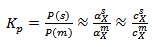
The proportionality constant, also known as the partitioning coefficient, is the ratio of the probability of a molecule to be in stationary phase to that in the mobile phase:
 |
(20.3) |
where, P(s) and P(m) represent the probabilities of the substance to be in the stationary and mobile phases, respectively. If p and q represent the fractions of the substance present in the mobile and stationary phases, respectively; Kp can be written as:
 |
(20.4) |
After equilibration, the mobile phase of separating funnel 0 is transferred to funnel 1 and fresh solvent is added to funnel 0, and the phases are equilibrated again. The mobile phases of funnels 0 and 1 are simultaneously transferred to funnels 1 and 2, respectively. This cycle is repeated to continue with the process with rest of the funnels. This experiment is diagrammatically represented in figure 1 for five separating funnels (0 – 4).