A. Dye-affinity chromatography-In this method, matrix is coupled to the reactive dye and the matrix bound dye has specificity towards a particular enzyme. For ex. Cibacron Blue F3G-A dye coupled to the dextran matrix has strong affinity towards dehydrogenases.
B. Metal-affinity chromatography-In this method, transition metals such as Fe2+, Ni2+ or Zn2+ is coupled to the matrix and the matrix bound metal form multidentate complex with protein containing poly-his tag (6x His). The affinity of protein for matrix bound metal is different and these differences are been exploited in metal affinity chromatography to purify the protein.
Covalent chromatography- This is a different type of chromatography technique where binding of analyte to the matrix is not reversible as it involves the formation a covalent bond between functional group present on matrix and analyte. Thiol group (-SH) present on neighbouring residues of protein forms disulphide bond after oxidation and under reducing environment, disulphide reversible broken back to free thiol group. The matrix in covalent chromatography has immobilized thio group which forms covalent linkage with the free thiol group containing protein present in the mixture (Figure 33.3). After a washing step to remove non-specifically bound protein, a mobile phase containing compound with reducing thio group is passed to elute the bound protein. The thio group containing compound present in mobile phase breaks the disulphide bond between protein and matrix thio group to release the protein in the mobile phase (Figure 33.3).
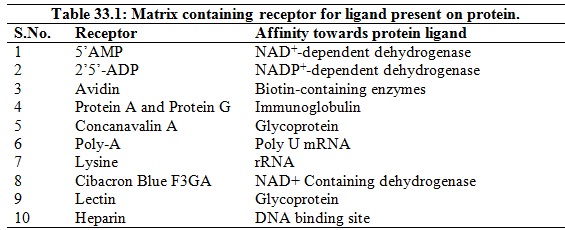
Choice of matrix for Affinity chromatography- Different popular affinity matrix used for protein purification is given in Table 33.1. The choice of matrix solely depends on the affinity tag present on the recombinant protein produced after genetic engineering.