Introduction: The chromatography techniques we discussed so far were exploiting different types of interactions between the matrix and the group present on the analyte but these chromatography techniques are not specific towards a particular analyte per se. The generalized chromatography approaches needs higher sample volume to isolate the molecule of interest. In the current lecture we will discuss another chromatography technique where a chromatography matrix is specific for a particular molecule or group of protein.
Principle: The affinity chromatography works on the principle of mutual recognition forces between a ligand and receptor. The major determinants, responsible to provide specificity are shape complementarity, electrostatic, hydrogen bonding, vander waal interaction between the groups present on the ligand-receptor pair (Figure 33.1). A mutual interaction between a ligand (L) and receptor (R) forms ligand-receptor complex (RL) with a dissociation constant Kd, which is expressed as follows-
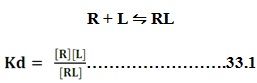
Dissociation constant is specific to the receptor-ligand pair and number of interaction between them. when a crude mixture is passed through an affinity column, the receptor present on the matrix reacts with the ligand present on different molecules. The mutual collision between receptor on matrix and ligands from different molecule test the affinity between them and consequently the best choice bind to the receptor where as all other molecules do not bind and appear in flow through. A wash step removes remaining weakly bound molecules on matrix. Subsquently, a counter ligand is used to elute the bound molecule through a competition between the matrix bound molecule and counter ligand (Figure 33.2).