The description of different structural feature of eukaryotic cell is as follows-
Different organelles of Eukryotic cells (Animal)
1. Cytosol- Cytosol is the liquid part filled inside the cell and it contains water, salt, macromolecules (protein, lipid, RNA). It has an array of microtubule fiber running through out the cytosol to give vesicular structure to its destination. Besides this, cytosol exhibits “Sol” to “Gel” transition and such transition regulates multiple biochemical and cellular processes.
2. Nucleus- Nucleus is the central processing unit of cell and homologous to the processor in a typical computer (Figure 3.3, A). The liquid filled inside nucleus is called as nucleoplasm . It is a viscous liquid containing nucleotides and enzymes to perform replication, transcription, DNA damage repair etc. It contains genetic material (DNA) in a complex fashion involving several proteins (histones) to pack into nuclear bodies or chromosomes. The chromatin in eukarotic nucleus is divided into euchromatin or heterochromatin . Euchromatin is a part of chromatin where DNA is loosely packed and it is transcriptionally active to form mRNA where as Heterochromatin is more densily packed and it is transcriptionally inactive. Nuclei in eukarytotic cells are present in a double layer of membrane known as nuclear envelope (Figure 3.3, B). Outer membrane of nuclear envelope is continuous with the rough endoplasmic reticulum and has ribosome attached to it. The space between these two membranes is called as perinuclear space . Nuclear envelope often has nuclear pore and as per calculation an average nucleus has 3000-4000 pores per nuclear envelope.
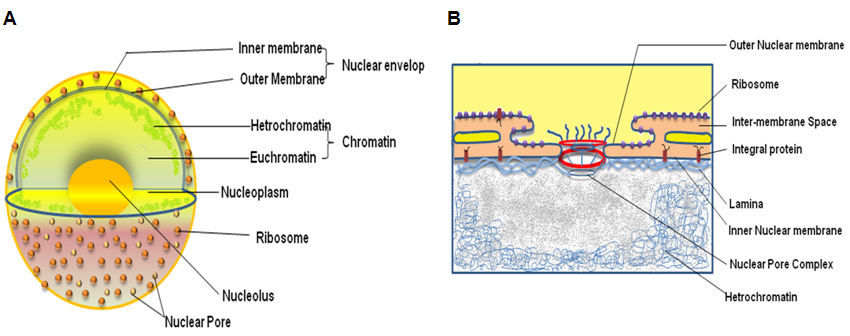
Figure 3.3: Structural details of nucleus. (A) whole and (B) enlarged view of nuclear pore.
Nuclear pore is 100nm is diameter and consists of several proteins. It is a gateway for transfer of material between nucleus and cytosol. RNA formed after transcription from DNA within the nucleus and move out of the nucleus into the cytosol through nuclear pore. Similarly protein from cytosol crosses nuclear pore to initiate replication, transcription and other processes.