Light microscopes come in two designs: upright and inverted (Figure 15.4).
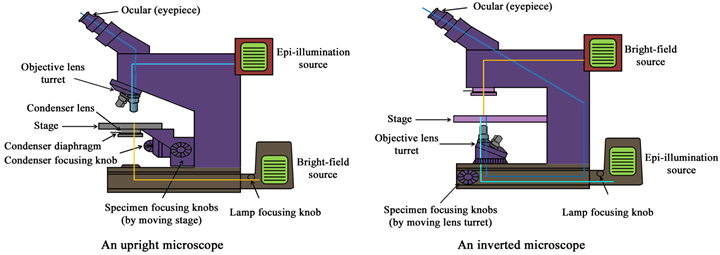
Figure 15.4 Designs of upright (A) and inverted (B) microscopes
In an upright microscope, the objective turret is usually fixed and the image is focused by moving the sample stage up and down. In an inverted microscope, the sample stage is fixed and objective turret is moved up and down to focus the final image. Inverted microscopes offer certain advantages over upright microscopes and are therefore becoming more popular:
- As the objective turret is at the bottom of the stage, the sample stage is more accessible allowing manipulations of the sample.
- The specimen need not be covered at the top by a coverglass.
- The centre of mass is closer to the bench thereby providing more mechanical stability to the microscope.
- Inverted design provides an excellent platform for attaching the total internal reflection fluorescence accessories (discussed later in this lecture).
Autofluorescence
Many of the essential molecules, that are present in all the cells, are fluorescent. These include B-vitamins, flavins, cytochromes, nucleotides (FMN, FAD, NADH), etc. The background fluorescence from these molecules is maximum when cells are excited in the UV/blue region. The fluorescence from these endogenous molecules can be mistaken for the signal fluorescence and therefore needs to be carefully analyzed.