18.2 Trials with DNA vaccines:
After several failures the first fairly successful DNA vaccination result in humans was attained with a malaria- specific DNA vaccine. This trial validated the rise of vaccine specific T cells in the peripheral blood of 11 out of 20 malaria-naive volunteers after three intramuscular pDNA (plasmid DNA) inoculations. However the investigation did not evaluate clinical gain. Several trials have offered evidence of principle for the ability of DNA vaccines to induce humoral and cellular immune responses in humans. Although, the immune responses analyzed were not as good as expected from the preclinical studies in any of these trials. For example, HIV-infected patients with huge viral counts generated a normal T-cell response against HIV Nef following DNA vaccination with a DNA vaccine encoding several HIV antigens, with no effect on viral counts.In an attempt to blend the qualities of DNA vaccines with those of adenoviral- or MVA-based vaccines, so-called ‘heterologous prime-boost' systematic plans have been developed. In these plans the potent but broad immunity induced by MVA- or adenoviral- based vaccines gets focused on the appropriate antigens by DNA vaccination which is highly specific. Recently investigations based on DNA vaccines have shifted largely to tumor antigens and the reason behind it might be the excelling funding opportunities in this field.
Figure 18.4 Techniques of delivering DNA vaccine:
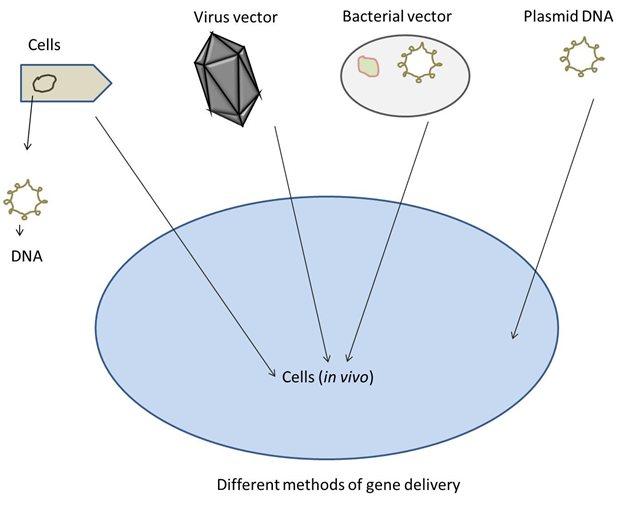
Due to discouraging results in the clinical trials, the DNA vaccination field is putting a lot of attention on upgrading the delivery methods, carrier molecules and genetic optimization of the construct used. Generally administration of DNA vaccines is done either by intramuscular (IM) or by intradermal (ID) route. Following IM route the antigen mainly is generated in muscle cells and this route promises high antigen expression but does not prove to be very immunogenic because muscle cells generally lack antigen presenting cells. On the contrary ID route has scanty antigen expression but it is much more immunogenic as compared to IM because skin serves as the essential gate for the entry of pathogens and is always abundant with antigen presenting cells.Various other devices have been designed for efficient DNA delivery like ‘Gene Gun'. Along with the gene gun techniques like electroporation and “Particle mediated epidermal delivery” (PMED) are also in use.These are also known as Second generation DNA vaccines. Multiple projects working on DNA vaccine rely on different methods. Various other techniques require the use of naked pDNA wherein it is worked out in a nanoparticle composed of lipids or polymers so that pDNA stability increases and thus resulting in higher cellular uptake.