5.3 Feature of adaptive immunity
The adaptive immunity has some fundamental properties.
5.3.1 Specificity
The adaptive immunity is specific to a particular antigen, which means specific antibodies are produced against a particular antigen. The structures present over the antigen that stimulate the production of antibodies are called antigenic determinants or epitopes . Minute differences exist among lymphocytes that express membrane receptors which are able to distinguish fine differences present on the epitopes. The specificity of immune system leads to a huge population of lymphocytes that are antigenically specific and are called lymphocyte repertoire.
5.3.2 Diversity
The ability of lymphocyte repertoire to recognize a wide variety of antigens is called diversity. In fact lymphocyte repertoire that contains receptors for different antigen contributes to a large population of extremely diverse lymphocyte clones.
5.3.3 Memory
The ability of the immune system to remember the antigens and respond again to the same upon exposure is called immunological memory. The immune response against the second exposure of the same antigen or subsequent exposure is usually rapid and larger than the primary immune response (figure 5.2).
Figure 5.3 Memory response of the adaptive immune system:
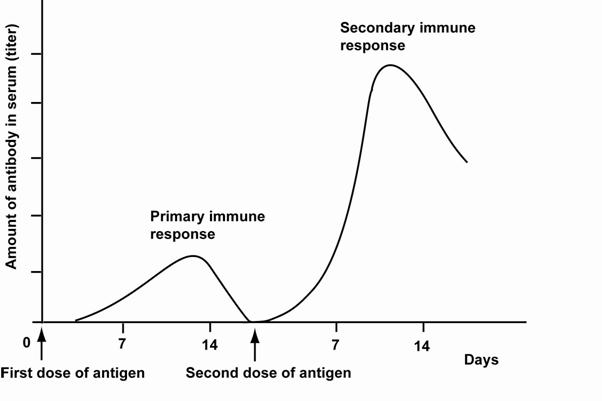
Immunologic memory forms because of long-lived memory cells generated upon each exposure of an antigen and are specific for that antigen. The memory cells produced following second exposure are more efficient in eliminating the antigen as compared to the primary immune response.