·
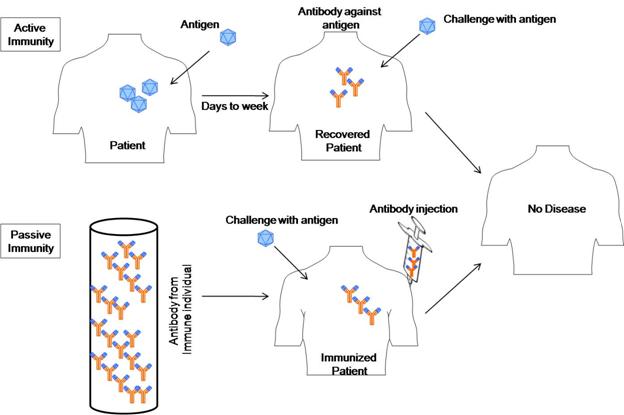
Immunity against a pathogen is usually induced by the exposure of microbial antigen to the host and is called active immunity . Immunity can also be transferred by serum or lymphocyte from an immunized individual to a diseased individual and is called passive immunity . Passive immunization is a rapid way to transfer the immunity in the absence of active immunity. Passive immunization against toxin and venoms is a life saving treatment in many lethal conditions (Tetanus toxoid, snake antivenom).
Figure 5.2 Schematic representation of active and passive immunity:
The first concept of humoral immunity was given by Emil von Behring and Shibasabro Kitasato ; they showed for the first time that serum transferred from a recovered diphtheria patient protected the recipient from active diphtheria infection. The active ingredients are called antitoxins because they nullify the effect of toxins. They won the noble prize for their landmark discovery. Paul Ehrlich coined the term antibodies for the proteins present in the serum and showed that it is capable to bind and neutralize the toxins. The substances that induce the production of antibodies are called antigens . The definition of the antigen changed in due course of time with the modern discoveries. The antigens are defined as substances that bind to a specific lymphocyte with or without further production of antibody. However the substances that induce the production of antibodies are called immunogens in modern immunology world.
The cellular theory of immunity started with the work of Elie Metchnikoff , who first demonstrated the phenomenon of phagocytosis. Another remarkable finding was put forth by Almroth Wright, who showed that the factors present in the serum can coat the bacteria and help them to phagocytize by the cells of the immune system, the process known as opsonization .